

All data is current as of August 2026.
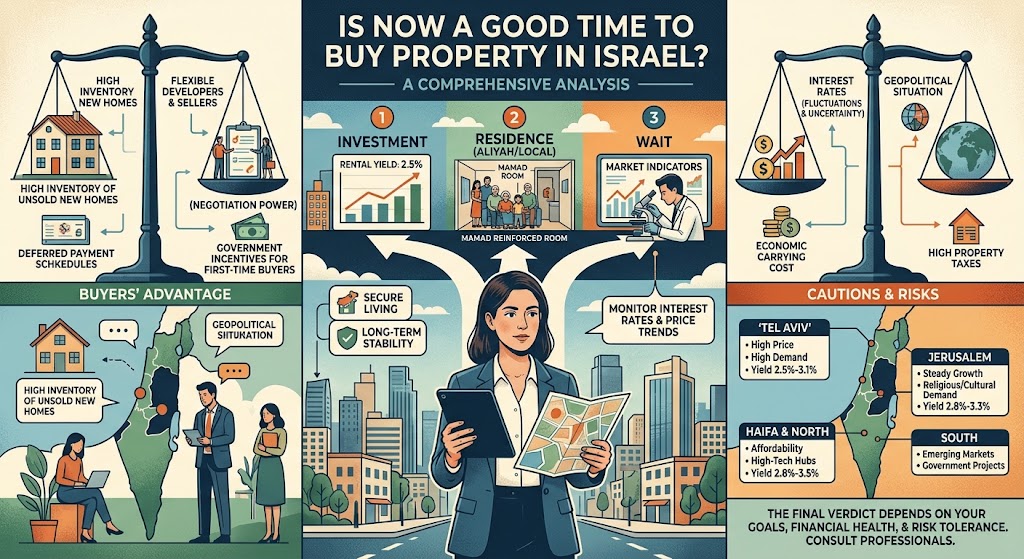
For much of the past two years, Israel’s residential market has rewarded sellers. That balance has shifted. Interest rates are easing, new housing supply sits at a record high, and developers are showing more flexibility on price and terms than at any point since the war. For a buyer weighing when to act, the direction of the data points toward now rather than later.
Interest Rates and Financing
The Bank of Israel cut its benchmark rate to 3.5% in July 2026, the fourth cut in a series that began in late 2025. The central bank’s own forecast puts the rate at around 3% within twelve months, alongside inflation holding near the middle of its target range.
Rates are still above where they sat earlier in the last decade, but the trend is downward and increasingly predictable. For a buyer financing part of a purchase, that means mortgage terms that are easier to plan around than they were a year ago, and room to negotiate financing rather than accept a fixed rate on a seller’s timeline.
Supply and Room to Negotiate
The Central Bureau of Statistics counted roughly 86,000 new homes still unsold at the start of 2026, equal to well over two years of supply at current sales rates. That is among the highest inventory levels on record, and it has changed who holds leverage in a transaction.
Developers are responding with flexible payment structures, upgraded finishes, and postponed mortgage payments rather than always cutting the headline price. In parts of Tel Aviv, where new supply has been heaviest, some projects have moved on price directly. The picture varies by city and by segment. A landmark villa in Caesarea and a standard apartment in central Tel Aviv are not competing for the same buyer, and the two markets are not softening at the same pace. What holds across most of the country is that a buyer today can expect more room to negotiate than a buyer would have found two years ago.
The same supply glut means new construction is easier to find on favorable terms than it was during the last decade’s shortage. Buyers who prioritize new-build standards, elevators, secure parking, and a mandatory Mamad safe room, no longer have to pay the premium that scarcity used to command.
Long-Term Resilience
Short-term conditions favor buyers. The longer-term case for Israeli property rests on structure rather than timing. Land in Israel’s central residential districts is permanently constrained, zoning is strict, and population growth continues to outpace most Western economies. Historical price data going back decades shows the market recovering from downturns faster than comparable markets abroad. None of that guarantees any individual year, but it is the reason buyers here have generally treated a purchase as a long-term hold rather than a short-term trade.
What a Foreign Buyer Should Still Weigh
Two factors do not move with the interest-rate cycle and are worth keeping in view.
Currency. A buyer holding US dollars, British pounds, or euros is exposed to the shekel’s movement for the length of the transaction. If the shekel strengthens against the buyer’s currency before closing, the effective cost of the property rises regardless of the agreed price. This has been a live issue recently, with the shekel trading near multi-decade strength against the dollar.
Rental yield. Gross residential yields in Israel typically run between 2.5% and 3.5%, low by international standards and lower still after taxes, management, and vacancy. This is not a market built for cash flow. It rewards buyers who are purchasing for long-term appreciation, for their own use, or both, which fits how most of our clients approach a purchase here in the first place.
Where This Leaves a Buyer
The rate cuts, the supply overhang, and developer flexibility together make the coming months a reasonable window to move, particularly for a buyer who has already chosen a city and is deciding on timing rather than location. Tel Aviv is a useful case study of how unevenly this plays out, since it is where the new supply has landed hardest and where negotiating room is currently most visible. For a foreign buyer, the harder part is rarely finding a property and more often navigating tax status, financing, and legal process from abroad; a step-by-step legal guide is worth reading before making an offer, not after. Current listings reflect where developers and sellers are showing the most flexibility right now.