
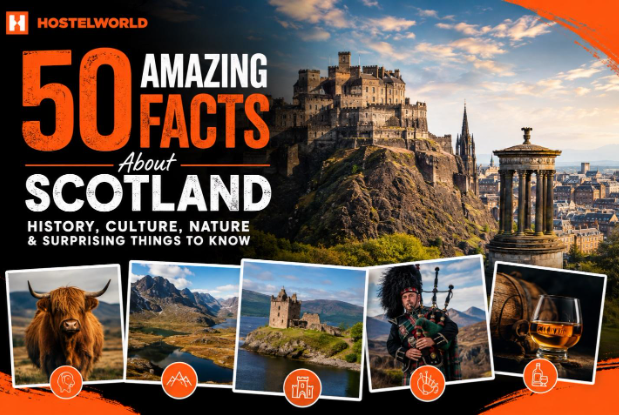
50 Amazing Facts About Scotland: History, Culture, Nature & Surprising Things to Know
Scotland is one of those destinations that seems familiar even before you visit. You may picture dramatic Highland mountains, ancient castles, Mistry lochs, tartan, bagpipes and historic cities-but there is much more to this remarkable country than its famous images suggest. From extraordinary inventions and ancient archaeological sites to unusual traditions and fascinating wildlife, Scotland has a story almost everywhere you look.
Whether you are planning your first Scottish adventure, researching the country for a school project or simply curious about what makes this northern nation so distinctive, these 50 facts offer a deeper introduction. They bring together geography, history, culture, inventions, cities, traditions and some of the more surprising details that make Scotland such an interesting country to explore.
For travelers arriving in the west of the Scotland, Glasgow is an excellent starting point for discovering the wider country. The city provides convenient access to the highlands, Loch Lamond, the west coast ana many other attractions, while local transport can make journeys between the airport, city centre and surrounding destinations considerably easier. Glasgow taxis can be a practical option when you want a direct journey rather than navigating several connections with luggage.
Scotland’s appeal becomes even clearer when you look beyond its famous landmarks. Ancient settlements sit alongside modern cities. Traditional languages continue to be spoken, and some of Europe’s most dramatic landscapes can be reached within a relatively short journey from major urban centers.
For visitors planning a longer Scottish itinerary, understanding the country’s geography is particularly useful. Edinburgh, Glasgow, Stirling, Loch Lamond, the Highlands the west coast and the Islands all offer very different experiences, so a little research before travelling can help you make better use of your time.
For travelers arriving by air, Glasgow is also an important gateway to western Scotland. After landing a Glasgow Airport Taxi can provide a straightforward connection to accommodation or another destination without requiring several public-transport changes, particularly when travelling with children, luggage or a larger group.
Scotland at a Glance
Before exploring the 50 facts about Scotland individually, here are a few quick Scotland country facts to put the country into perspective:
| Quick fact | Information |
|---|---|
| Country | Scotland |
| Part of | United Kingdom |
| Capital | Edinburgh |
| Largest city | Glasgow |
| Population at the 2022 Census | 5,436,600 |
| Officially recognized cities | 8 |
| National animal | Unicorn |
| National flower | Thistle |
| National flag | Saltire |
| Highest mountain | Ben Nevis |
| Famous freshwater loch | Loch Ness |
| Main languages | English, Scots and Scottish Gaelic |
| National day | St Andrew’s Day |
| Famous celebration | Hogmanay |
| UNESCO City of Music | Glasgow |
| UNESCO City of Design | Dundee |
The and the themes above reflect the source material used for this article, including official census and heritage information referenced in the original draft.
50 Amazing Facts About Scotland
-
Scotland Is One of Four Countries in the UK
Scotland is one of the four constituent countries of the United Kingdom, alongside England, Wales and Northern Ireland, It occupies the northern part of the Great Britain and has its own distinctive legal, educational and cultural traditions.
That separate identity is one reason visitors often notice significant differences between Scotland and other parts of the UK.
2. Edinburgh Is Scotland’s Capital
Edinburgh has been Scotland’s capital since the 15th century and is one of the country’s most historically important cities.
Its Old Town and New Town form a UNESCO world heritage site, bringing together medieval streets, historic buildings and elegant Georgian architecture.
For visitors, this creates an unusual experience: you can walk a relatively short distance and move between several centuries of architectural history.
- Scotland Has a Population of More Than Five Million
The 2022 Scottish Census recorded a population of 5436600 the largest population recorded by a Scottish census at that time.
More recent population estimates are higher, so the figure you see can vary depending on the year and source. The census figure nevertheless provides an important official benchmark.
- Scotland Has Eight Officially Recognized Cities
Scotland’s eight officially recognised cities are:
- Aberdeen
- Dundee
- Dunfermline
- Edinburgh
- Glasgow
- Inverness
- Perth
- Stirling
Each has it own character. Edinburgh is strongly associated with history and architecture, Glasgow with music and culture, Dundee with design and Aberdeen with its distinctive granite architecture.
5. Scotland Has More Than 30,000 Freshwater Lochs
One of the most memorable things about the Scotland is its abundance of freshwater. The country has more than 30,000 freshwater lochs, ranging from small bodies of water to enormous lochs surrounded by mountains, forests and moorland. This extraordinary abundance of water is a major reason Scotland’s landscapes look so different from one region to another.
6. Glasgow Is Scotland’s Largest City
Glasgow is Scotland’s largest city by population and one of it’s major cultural and commercial center. It is particularly well known for music, architecture, museums, restaurants and its lively atmosphere.
The city also makes an excellent base for exploring western Scotland, with attractions such as Loch Lamond, the Trossachs and the wider Highlands accessible from the area.
7. Ben Nevis Is Britain’s Highest Mountain
At 1345 meters, Ben Nevis is the highest mountain in the United Kingdom. It stands close to Fort William in the Scottish Highlands and attracts hikers from across Britain and around the world.
The mountain should not, however be underestimated. Weather conditions can change rapidly at higher elevations, making preparation essential.
8. Scotland’s National Animal Is the Unicorn
Perhaps one of the strangest facts about Scotland is that its national animal is not a deer, eagle or other native species.
It is the Unicorn.
The mythical creature has been associated with Scottish symbolism fr centuries and became part of Scottish royal imagery.
9. Scottish Gaelic Has Been Spoken for More Than 1,500 Years
Scottish Gaelic is an important part of Scotland’s linguistic and cultural heritage. The language has been spoken in Scotland for more than 1500 years and remains particulary significant in the Highlands and islands.
The 2022 census recorded 69,701 people who could speak Gaelic.
10. Scots Is More Than an Accent
Scots is another important indigenous language of Scotland. It has its own vocabulary, literature and historical development and should not simply be treated as an accent of English.
The 2022 Census recorded more than 1.5 million people reporting that they could speak Scots.
Scotland’s Languages at a Glance
| Language | Importance |
|---|---|
| English | Main everyday language |
| Scots | Indigenous language with a rich literary tradition |
| Scottish Gaelic | Historic Celtic language with strong Highland and island connections |
11. Scotland’s Flag Is Called the Saltire
The Scottish flag is known as the Saltire. It features a white diagonal cross against a blue background and represents St Andrew, Scotland’s patron saint. It is now one of the most recognizable national flags.
12. St Andrew’s Day Is Scotland’s National Day
St Andrew’s Day takes place every year on 30 November. The day celebrates Scotland’s patron saint and is marked by music, dancing, food and cultural events. Traditional celebrations can include ceilidh dancing, where groups dance to Scottish traditional music.
13. Scotland Has a Long and Complicated History
Scotland’s history stretches back thousands of years.
Its story includes:
- prehistoric communities
- Pictish culture
- Celtic traditions
- Viking influence
- medieval kingdoms
- powerful monarchs
- wars and political conflicts
- the development of modern Scotland
This layered history explains why Scotland has such a strong connection between its landscapes and its past.
14. The Scottish Parliament Was Re-established in 1999
The modern Scottish Parliament was re-established in 1999 following devolution. It has legislative responsibilities in areas including education, health, justice and the environment, while other powers remain reserved to the UK parliament.
15. Edinburgh’s Old and New Towns Are UNESCO Listed
Edinburgh’s Old town preserve its medieval character, while the New Town is famous for Georgian planning and architecture. UNESCO recognized the combined area as a World Heritage Site since in 1995. It is one of the best places in Scotland to see how different historical periods have shaped the same city.
16. Orkney Has Extraordinary Ancient Archaeology
The heart of Nolithic Orkney contains some of Scotland’s most important prehistoric monuments.
The archaeological landscape provdes evidence of sophisticated communities living in Orkney thousands of years ago and demonstrates that Scotland’s history extends far beyond its medieval castles and famous battles.
17. Scotland Is the Home of Golf
Golf has deep historical connections with Scotland and St Andrews is internationally recognized as the “Home of Golf”. Scotland’s coastal links courses have played a mojor role in shaping the modern game and remain a major attraction for golfers from around the world.
18. Whisky Is Closely Connected With Scottish Identity
Scottish whisky is one of Scotland’s most internationally recognized products. Whisky-making has a stretching back century, while the Gaelic expression uisge beatha, meaning “water of life”, is associated with the development of the whisky.
19. Scotland Has Hundreds of Islands
Scotland is famous for its dramatic Islands, many of which have their own landscapes, communities and traditions.
The country’s island groups include:
- Hebrides
- Orkney
- Shetland
For travellers interested in remote landscapes, wildlife and coastal scnery, Scotland’s islands can provide an entirely different experience from its mainland cities.
20. Loch Morar Is Exceptionally Deep
Loch Morar reaches approximately 310 meter at its deepest point. That makes it deeper than many people might expect from a Scottish freshwater loch and gives it an impressive place among the country’s natural features.
21. Loch Ness Is Famous Around the World
Loch Ness is arguably Scotland’s most internationally famous loch. Its reputation is strongly connected with the legendary Loch Ness Monster, but the area is a much more than a monster story. The surrounding landscapes, historical sites and enormous body of water make Loch Ness one of Scotland’s best known visitor destinations.
22. Loch Lomond & The Trossachs Was Scotland’s First National Park
Established in 2002 Loch Lomond & The Trossachs became Scotland’s first national park. It covers approximately 1865 square kilometers and includes mountains, forests, rivers, lochs, and walking routes. Its relative proximity to Glasgow also makes it particularly convenient for vistors based in the city.
23. Scotland Is Famous for Munros
A Munro is a Scottish mountain higher than 3000 feet. Climibing Munros has become a popular challenge among hikers. Some are relatively accessible, while other requires serious preparation and mountain experience.
For anyone considering Munro hike, checking weather conditions and understanding the route should be a priority.
24. Scotland Has an Extraordinary Coastline
Scotland’s coastline is remarkably varied.
You can find:
- dramatic cliffs
- sandy beaches
- rocky shores
- sea lochs
- sheltered bays
- offshore islands
- remote fishing communities
The western coastline in particular can feel completely different from the urban environments of Glasgow and Edinburgh.
25. Scotland Is Famous for Its Castles
Scotland’s Castles and among its most recognizable attractions. But they all are not the same. Some were military fortresses, others were aristocratic residences, and many are now atmospheric ruins. Castle Sween for example is considered the oldest castle on the Scottish mainland that can be confidently dated with origins in the 1100s.
26. Scottish Castles Reflect Centuries of Conflict
Scotland’s Castle-building tradition was influenced by warfare, changing military technology and the power of noble families. Hails Castle for example dates from the early 1200s and was connected with important Scottish noble families.
Famous Scottish Features at a Glance
| Feature | What Scotland is known for |
|---|---|
| Mountains | Ben Nevis and Munros |
| Lochs | Loch Ness, Loch Morar and Loch Lomond |
| Islands | Hebrides, Orkney and Shetland |
| Castles | Fortresses, ruins and historic residences |
| Golf | St Andrews and coastal links |
| Coastline | Beaches, cliffs, bays and sea lochs |
27. The Thistle Is Scotland’s National Flower
The thistle is one of Scotland’s most recognizable national symbols. It appears in heraldry, souvenirs, sporting imagery and other representations of Scottish identity. Its distinctive appearance has helped make it one of the country’s most enduring symbols.
28. Tartan Has a Deep Cultural Connection
Tartan is another instantly recognizable Scottish symbol. Different patterns became associated with families, regions and organizations over time. However, the history id Tartan is more complicated than the popular idea that every ancient Scottish clan always had one fixed tartan pattern. Today, tartan remains important in clothing, ceremonies and contemporary Sottish design.
29. Bagpipes Are Strongly Associated with Scotland
The great Highland bagpipe has become one of the most recognizable sounds associated with Scottish culture.
It is commonly heard during:
- Highland gatherings
- ceremonies
- parades
- cultural festivals
- formal occasions
Its distinctive sound is difficult to confuse with any other instrument.
30. Scotland Has a Rich Folklore Tradition
Scottish folklore is full of fascinating stories involving supernatural beings and legendary creatures.
Traditional stories include:
- unicorns
- kelpies
- selkies
- witches
- ghosts
- other supernatural creatures
These stories remain an important part of Scottish storytelling and tourism.
31. The Kelpies Are Giant Horse Sculptures
The kelpies near Falkirk are enormous steel sculptures inspired by the mythical water horses of Scottish folklore.
They have become one of Scotland’s most recognizable modern landmarks and demonstrate how traditional mythology continues to influence contemporary Scottish art.
32. Scotland Has Produced Remarkable Inventors
Scottish inventors and scientists have made major contributions to modern life.
Some innovations associated with Scottish inventors include:
- Television technology
- Fingerprint identification
- The ATM
- Improvements to the steam engine
- Medical technology
This scientific heritage is one of the less obvious but particularly interesting sides of Scotland.
33. John Logie Baird Helped Develop Television Technology
John Logie Baird, who was born in Helensburgh, Scotland, demonstrated a working television system in 1926.
His later work also contributed to colour television and transatlantic television transmission.
That make him an important figure in the history of modern communications.
34. A Scottish Inventor Helped Develop the ATM
James Goodfellow from Paisley developed technology behind the automated teller machine and the PIN system during the 1960s. His work contributed to a technology that has become an everyday part of modern banking.
35. Scotland Made Major Contributions to Medical Science
Scottish physicians and inventors have played significant roles in medical innovation. Alexander Wood for example developed the hypodermic syringes in the 19th century. This is another example of how Scotland’s contribution far beyond its traditional cultural image.
36. Scotland Has a Strong Scientific Heritage
Scotland has produced numerus influential scientists and engineers.
Among the best-known names are:
| Scottish figure | Associated contribution |
|---|---|
| James Clerk Maxwell | Physics and electromagnetic theory |
| James Watt | Steam-engine improvements |
| Alexander Fleming | Medical science and antibiotics |
| John Logie Baird | Television technology |
| James Goodfellow | ATM and PIN technology |
This scientific heritage exists alongside Scotland’s literature, music, traditions and cultural landscapes, giving the country a surprisingly broad intellectual history.
37. Robert Burns Is One of Scotland’s Best-Known Poets
Robert Burns is one of the most important figures in Scottish literature. His work is celebrated every year around Burns Night, held on 25 January. Traditional celebrations can include poetry, music, speeches and Scottish food.
38. Burns Night Is Celebrated Around the World
Burns night is not limited to Scotland. Scottish communities and enthusiasts around the world celebrate Burns legacy with traditional dinners and cultural events.
It demonstrates how Scottish literature and traditions have travelled far beyond the country’s borders.
39. Hogmanay Is Scotland’s Famous New Year Celebration
Hogmanay is Scotland’s traditional New Year celebration.
It is associated with:
- music
- gatherings
- fireworks
- dancing
- traditional customs
- street celebrations
Edinburgh’s Hogmanay celebrations have become particularly famous internationally.
40. Scotland’s Landscapes Are Remarkably Diverse
One of the most interesting facts on Scotland is how quickly its scenery can change.
A journey can take you from a busy city to:
- forests
- lochs
- mountains
- beaches
- glens
- moorland
- remote islands
That diversity is one of Scotland’s greatest attractions for road trips and touring holidays.
41. Scotland Is Home to Remarkable Wildlife
Scotland supports an impressive variety of wildlife.
Species associated with the country include:
- red deer
- golden eagles
- otters
- seals
- puffins
- red squirrels
Coastal and island areas can be particularly rewarding for visitors interested in wildlife.
42. The Highlands Are More Than Just Mountains
It is easy to picture the Highlands simply as a region of mountains, but that description leaves out much of what makes them special.
The Highlands include:
- glens
- lochs
- forests
- moorland
- coastline
- islands
- historic communities
It is a geographically and culturally diverse region rather than a single type of landscape.
43. Scotland’s Cities Have Very Different Personalities
Scotland’s cities are surprisingly diverse.
| City | Particularly known for |
|---|---|
| Edinburgh | History, festivals and architecture |
| Glasgow | Music, culture and architecture |
| Dundee | Design and innovation |
| Aberdeen | Granite architecture and North Sea connections |
| Stirling | History and heritage |
| Inverness | Highland location and access to northern landscapes |
This diversity allows travelers to experience several distinct sides of Scotland within one trip.
44. Scotland Has Numerous UNESCO Connections
Scotland has an impressive collection of UNESCO designations covering heritage, natural environment, literature, music, design and other areas of cultural significance. The country’s UNESCO recognition demonstrates that Scotland’s importance extends well beyond traditional tourism.
45. Dundee Is a UNESCO City of Design
Dundee is recognized as a UNESCO city of design, reflecting its contribution to design and innovation.
The city also home to V&A Dundee, giving visitors a opportunity to explore a more contemporary side of Scottish culture.
46. Glasgow Is a UNESCO City of Music
Glasgow’s reputation for live music is internationally recognized. The city became UNESCO city of Music and has developed a strong tradition of live performance across a wide range of musical genres.
47. Modern Scotland Is Increasingly Diverse
The 2022 Census showed that population growth since 2011 was strongly influenced by migration. The number of people living in Scotland were born outside the country increased substantially, reflecting the increasingly diverse character of modern Scottish society.
48. Scotland Has a Relatively Low Population Density
The 2022 Census recorded approximately 70 residents per square kilometer across Scotland. However, the national average hides a major contrast between densely populated urban areas and much more sparsely populated Highland and island communities.
This helps explain why Scotland can feel remarkably spacious once you leave its major cities.
49. Scottish Weather Can Change Quickly
Scottish weather is famously changeable, particularly in mountainous and coastal areas. A Sunny morning does not necessarily guarantee a dry afternoon, which is why visitors should prepare for changing conditions.
Practical packing checklist
- Waterproof jacket
- Comfortable walking shoes
- Warm layers
- Small day bag
- Water bottle
- Weather-appropriate clothing
- Extra layer for mountain or coastal areas
The basic rule is simple: prepare for changing weather conditions rather than relying on the morning forecast alone.
50. Scotland Is Best Understood Through Its Variety
Perhaps the most important of all these facts about Scotland is that no single image can represent the country.
Scotland is simultaneously:
- ancient and modern
- urban and rural
- traditional and innovative
- historic and contemporary
- densely populated in places and remarkably remote in others
It has medieval streets and modern museums, remote islands and vibrant cities, historic castles and contemporary architecture, ancient languages and globally connected communities. That variety is ultimately what make travelling through Scotland so rewarding.
Why These Scotland Facts Matter to Travelers
Reading about Scotland facts online is useful, but seeing the country in context make s those details much more meaningful.
A statistic about mountains becomes more interesting when you see the scale of Highland peak. A historical date has more meaning when you walk through Edinburgh’s Old Town. A discussion about Gaelic becomes more tangible when you encounter bilingual signs in parts of the highlands and islands.
The best way to understand the things about Scotland that makes it distinctive is therefore to combine research with exploration. If you are planning a Scottish holiday, consider combining one of major cities with destinations beyond the urban centers.
A sample Scotland itinerary could include:
| Stop | What to experience |
|---|---|
| Edinburgh | Old Town, New Town and historic architecture |
| Glasgow | Music, culture, museums and architecture |
| Loch Lomond | Loch scenery and outdoor activities |
| Stirling | Scottish history and heritage |
| Highlands | Mountains, glens and dramatic landscapes |
| West Coast | Coastal scenery and island connections |
Allow enough time for slower journeys. Some of the most memorable scenery appears between major attractions rather than at the destination itself.
Frequently Asked Questions About Scotland
What is Scotland most famous for?
Scotland is particularly famous for its Highlands, castles, lochs, whisky, tartan, bagpipes, golf, historic cities and rich cultural traditions. It is also recognised for major contributions to science, engineering and literature.
What are five interesting facts about Scotland?
Five particularly interesting facts are:
- Scotland’s national animal is the unicorn.
- The country has more than 30,000 freshwater lochs.
- Ben Nevis is Britain’s highest mountain.
- Scottish Gaelic has been spoken in Scotland for more than 1,500 years.
- Scottish inventors have contributed to technologies including television and the ATM.
What are three things Scotland is famous for?
Three of the most internationally recognised Scottish traditions are whisky, tartan and bagpipes. However, Scotland is equally famous for its castles, landscapes, golf, literature, wildlife and cultural festivals.
What is Scotland’s capital?
Edinburgh is Scotland’s capital. It has served as the Scottish capital since the 15th century and is home to the Scottish Parliament.
What is Scotland’s national animal?
Scotland’s national animal is the unicorn, a mythical creature that has long been associated with Scottish royal symbolism.
What languages are spoken in Scotland?
English is the main everyday language, while Scots and Scottish Gaelic are important parts of Scotland’s linguistic and cultural heritage. Gaelic has particularly strong historical connections with the Highlands and islands.
How many people live in Scotland?
The 2022 Scottish Census recorded 5,436,600 people. More recent population estimates are higher, so the exact number depends on the date and source being used.
What is Scotland famous for besides whisky?
Scotland is famous for its mountains, lochs, islands, castles, golf, literature, festivals, music, traditional food, wildlife and contributions to science and engineering.
What is the best way to explore Scotland?
There is no single best method for every traveler. Cities are generally easy to explore on foot and by public transport, while private transport, car travel or organized tours can be more practical for reaching remote Highland, coastal and island destinations.
The best option depends on your itinerary, group size, budget, luggage and the amount of time available.
Final Thoughts
These 50 Scotland facts only scratch the surface of what makes the country fascinating.
Scotland’s appeal comes from the way its history, landscape, culture and modern life overlap. Ancient monuments stand beside modern cities; traditional music continues alongside contemporary culture; and dramatic natural scenery remains surprisingly close to major urban centers.
If you’re planning a trip, use these facts as a starting point rather than a checklist. Research the places that interest you most, allow time to explore beyond the famous landmarks, and leave room for unexpected discoveries.
A quiet Highland viewpoint, a coastal village, an old stone bridge or an unexpected conversation with a local can sometimes become more memorable than the attractions you originally planned to see.