

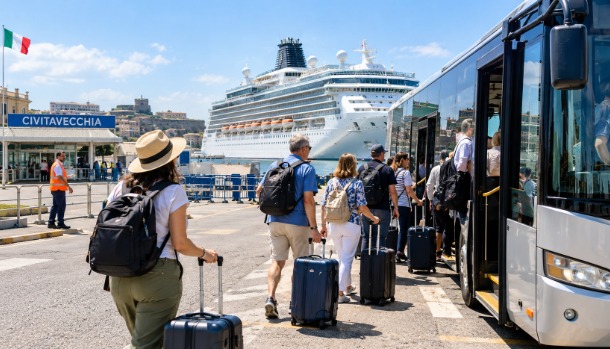
Civitavecchia is the port of Rome, and for most Mediterranean cruisers from the US and Canada it’s where the vacation officially begins. It’s also where a surprising number of them start it stressed, sweaty and sprinting for a check-in desk.
The port itself isn’t difficult. The problem is that embarkation day stacks several things you don’t control on top of each other: a transatlantic flight, a European border check, an hour-long trip from Rome and a cruise terminal with a hard cut-off. Get one of them wrong and the margin disappears.
These are the seven mistakes we see most often, and the simple fixes for each.
1. Booking a flight that lands too late
This is the big one. Many cruisers book the cheapest same-day flight, look at the sailing time on their ticket and assume a midday landing leaves plenty of room. It usually doesn’t.
Between touchdown at Rome Fiumicino and walking into the cruise terminal, you need to clear passport control, collect your bags, find your ride and drive about 67 km to the port. On a normal day that’s around three hours, and nothing about embarkation day is guaranteed to be normal. A late departure from New York or a missed connection in Frankfurt can wipe out your buffer before you’ve even left North America.
The fix: if you’re flying long-haul, arrive the day before. If you really must fly in on cruise day, work backwards from your check-in cut-off, not from the sailing time. This detailed guide explains how late you can safely land at Fiumicino on cruise day, with a timeline for each sailing time and each way of getting to the port.
2. Planning around the sailing time instead of the check-in cut-off
“The ship leaves at 6:00 PM” is the most misleading sentence on your cruise documents. What matters is when the terminal stops accepting passengers, and that is well before the ship sails.
Each cruise line sets its own rules, but cut-offs of 90 minutes to two hours before departure are common, and some lines want you on board even earlier if you haven’t completed online check-in. Many lines also give you an arrival appointment, and showing up hours ahead of it doesn’t always mean boarding early.
The fix: find two times in your cruise documents and write them down: your arrival window and the final check-in time. Plan your whole day around the second one. And finish online check-in before you leave home: it’s the easiest time you’ll save all day.
3. Underestimating passport control at Fiumicino
If you’re traveling on a US, Canadian or other non-EU passport, you now enter Italy through the EU’s Entry/Exit System (EES), fully operational since April 2026. On your first entry since it launched, the border registers your fingerprints and a photo, either at a self-service kiosk or at the booth. On later trips the process is faster.
The rollout has not been smooth. Italian airports saw long queues during the spring and summer peaks, and the temporary option to pause biometric checks when lines got too long expired in September 2026. Waits at Fiumicino now depend heavily on how many long-haul flights land just before yours, and most overnight flights from North America arrive in the same morning wave.
The fix: budget at least 45 minutes for passport control on cruise day, more if it’s your first trip to Europe since EES started. Keep your passport and your cruise documents in your hand luggage, not in your checked bag. ETIAS, the separate online travel authorization, isn’t in operation yet and has no confirmed start date; check the official EU site a few weeks before you fly.
4. Assuming the train takes you to the ship
The train between Rome and Civitavecchia is cheap and, on a good day, perfectly pleasant. But “the train goes to Civitavecchia” and “the train goes to your ship” are two very different things.
From Fiumicino Airport there is no direct train: you take one line into Rome and change for another to Civitavecchia. Civitavecchia station is in town, about a kilometer from the port, and the cruise piers have no pedestrian access. From the station you walk or take a local bus to Largo della Pace, the port’s passenger hub, and from there a free shuttle bus to your pier. It all works, but you’re doing it with full-size cruise luggage, steps, platforms and a lot of other passengers trying to do the same thing.
The fix: the train is a sensible choice if you spent the night in Rome and leave early in the morning, with time to spare. If you’re coming straight off a flight, traveling with kids or carrying a lot of luggage, a door-to-door option (cruise line coach, shared shuttle or private car) removes the transfers that eat the most time.
5. Forgetting to check for strikes
Transport strikes are a regular part of life in Italy, and they don’t pause for cruise season. A rail strike can cancel or delay the regional trains between Rome and Civitavecchia, and they are often called for Fridays and Mondays, which are also busy embarkation days.
The good news: Italian strikes are announced in advance and published on the Ministry of Transport’s official strike calendar. Some trains are guaranteed even during a strike, but only in fixed time bands, which may not match your schedule.
The fix: check the strike calendar for your travel date a week before you fly, then again two days before. If a rail strike is announced, switch to road transport rather than hoping your train is one of the guaranteed ones.
6. Not knowing which terminal your ship uses
Civitavecchia isn’t a single dock with a single building. Cruise ships berth at several different piers spread across the port, served by more than one terminal, and on a busy summer Saturday there can be four or five ships embarking at once.
Cruisers who just tell a taxi “the port” or follow the crowd off a shuttle can end up at the wrong terminal, then wait for another shuttle to the right one.
The fix: before the day, find your ship’s pier or terminal (it’s usually in your cruise documents or on the cruise line’s app). Whoever drives you, give them the ship’s name, not just “Civitavecchia”. Professional drivers check the day’s berthing plan and take you to the right terminal entrance.
7. Packing your essentials in your checked suitcase
At the terminal, porters take your big suitcases, and you won’t see them again until they’re delivered to your cabin. That can be late afternoon or even evening, while you’re already on board, hungry, warm and wishing you had your swimsuit or your blood pressure pills.
The fix: pack an embarkation day bag and keep it with you. At a minimum it should hold:
- passports, cruise documents and printed luggage tags
- any medication you’ll need in the next 24 hours
- phone chargers and an adapter
- a change of clothes and a swimsuit
- sunscreen, sunglasses and a refillable water bottle
Attach your luggage tags before you leave the hotel or the airport, not in the terminal queue.
Make the first day the easy one
Most embarkation day stress comes from trying to squeeze a flight, a border check, a cross-country trip and a check-in deadline into the same few hours. Give yourself a night in Rome or in Civitavecchia, know your real cut-off time, and travel to the port in a way that doesn’t depend on connections or strike-free trains.
Do that, and the first photo of your cruise will be a toast on the pool deck, not a selfie in a queue.