

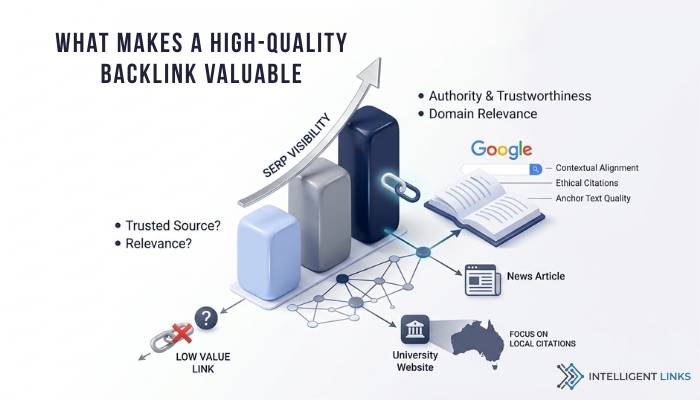
High-quality backlinks from trusted, relevant websites signal to Google that your content is worth ranking. But not every link pointing to your domain carries the same weight. Some of them push your position in the SERP upward, while others do nothing or even hurt your visibility.
At Intelligent Links, we work with Australian businesses on exactly this. We know that because search engines examine closely who is citing your website, backlink quality is a core element of off-page SEO. Yet most website owners don’t realise how wide the gap is between a qualified external link and one that lacks value.
In this article, you’ll learn what separates a valuable inbound link from a worthless one, how Google reads those signals, and what ethical citation building actually looks like in practice. Read on.
High-Quality Backlinks: What Actually Makes Them Worth Having
The source behind a backlink often carries more weight than the external link itself. For example, a link from a respected industry publication sends a much stronger signal than one from a directory site with little traffic or relevance.
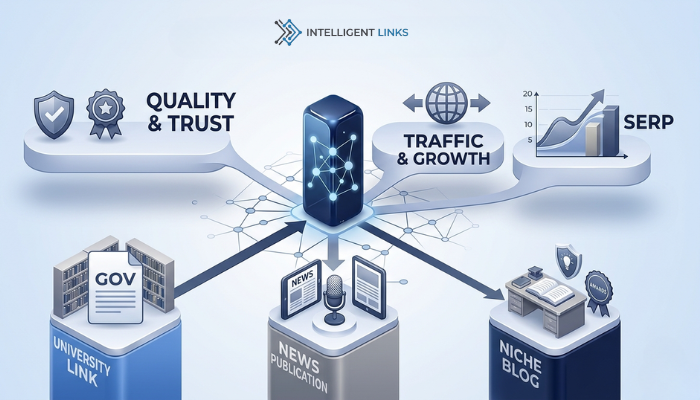
Search engines don’t just count how many sites link to a page. They assess:
- Where do those citations come from
- How closely the source relates to the topic
- Whether the link fits naturally within the content
The following two factors drive most of the weight a high-quality backlink carries.
Domain Rating and High Authority Sources
Domain rating measures the overall strength of a site’s external link profile on a scale from 0 to 100. A higher score means the page has earned links from other reputable, well-cited domains over time (even a single strong link from a high-rated website shifts things noticeably).
In practice, Google assigns more ranking value to links from high-authority sources than from pages with thin or unrelated materials. In fact, low-authority sites pass almost no value, no matter how many of them link to your website.
Anchor Text and Why the Right Wording Counts
Anchor text tells Google what your linked page covers, so the wording needs to match the topic of the page it points to.
The following three things are worth keeping in mind:
- Relevance Comes First: Keyword-focused anchor text helps search engines confirm what your page is about. But the phrasing needs to read naturally within the surrounding article.
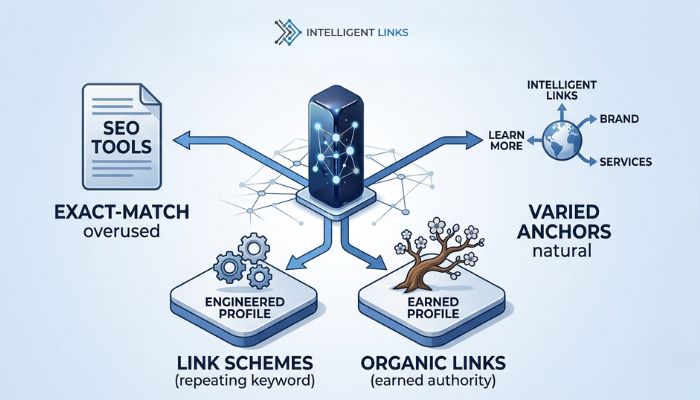
- Exact-Match Overuse Backfires: Repeating the same keyword-rich anchor text across large numbers of backlinks can appear unnatural and increase the risk of ranking issues.
- Variety Signals Authenticity: A mix of branded, generic, and keyword-focused anchor text creates a more natural external link profile and helps search algorithms assess links in context.
In short, varied anchor text is the safer and more sustainable approach. A profile built on one repeated phrase looks engineered. One built on natural variation looks earned.
How Websites Earn Links That Google Respects
Websites earn links that Google values by publishing useful articles, building genuine industry connections, and steering clear of manipulative tactics. In many cases, the strongest backlink profiles grow from consistent effort rather than short-term link-building campaigns.
From what we have seen across multiple campaigns, the businesses pulling in consistent organic traffic are the ones treating off-page SEO as a long-term investment.
And white hat SEO is the method behind that. It earns referring links through approaches that search engines actually reward rather than penalise.
Here are the most reliable ways Australian organisations build quality external links without cutting corners:
- Guest Posting on Reputable Sites: Publishing well-researched articles on industry-specific sites remains one of the steadiest ways to secure backlinks. It puts your brand in front of new audiences while earning direct links from authoritative websites.
- Content Marketing Through Original Research: Data-driven articles, original studies, and high-quality content naturally attract inbound links over time. Plus, relevant content gives other sites a genuine reason to reference your page, which drives organic shares and builds relationships across your niche.
- Digital PR and Media Coverage: Landing features on news sites through digital PR campaigns generate high-authority backlinks without any outreach manipulation. In fact, a single placement in a well-read publication can drive traffic and lift your search engine rankings simultaneously.
- Sponsoring Events and Community Involvement: Local businesses often overlook event sponsoring as a link-building strategy. In reality, sponsorships regularly produce structured citations and external links from engaged, locally related sites. These links further support local SEO and build brand recognition with local customers.
Executing these strategies effectively often requires access to publisher networks and a steady article pipeline. For sites that lack the time or resources to manage that internally, specialist providers can handle the process.
For instance, link-building specialists like those at Intelligent Links offer editorial placement services across Foundation, Accelerate, and Momentum packages. Our team writes the content and pitches it to topically relevant publishers on behalf of Australian businesses.
Brand Mentions, Google Business Profile (GBP) and the Signals Behind Them
Company mentions and a well-maintained Google Business Profile can strengthen your search presence before someone even clicks through to your website. These off-site signals help search engines see that your business is active, visible, and trusted across the web.
Unlinked brand mentions can still support that credibility, even without attaching a direct backlink (yes, without anyone clicking through, too). In our experience working with Australian enterprises, consistent name references across reputable platforms lift a website’s reputation steadily over time. Crawlers also read these signals as proof that an organisation is credible and worth surfacing in search results.
A well-optimised Google Business Profile further strengthens local SEO for businesses targeting local customers in specific areas. It even supports your broader link-building efforts by reinforcing business recognition across Google’s own platforms.
Together, brand mentions and GBP activity build a credibility footprint around your website. That footprint works alongside quality referring links and can support stronger organic traffic over time.
Black Hat SEO: Why Cheap Links Cost You More in the Long Run
Cheap links cost you more because Google’s algorithms specifically detect and penalise manipulative link-building practices. In short, black hat SEO is a gamble where you’ll almost always lose.
We’ve seen this happen repeatedly. Sites that rely on private blog networks, paid link schemes, and other deceptive tactics often lose visibility when Google catches on. In many cases, repairing the damage takes far longer than building a strong backlink profile through legitimate methods.
To see how this works in practice, let’s look at two key areas.
What Black Hat Link Tactics Look Like in Practice
Black hat SEO covers a range of fake methods that sites use to inflate their external link count artificially. Among those tactics, buying links, running private blog networks, and mass directory submissions are the most common ones.
In the worst case, some sites even embed links inside YouTube videos or push them across social platforms to manufacture volume.
Although these shortcuts produce short-term gains in search engine results, Google’s algorithm eventually identifies them. At times, even a single manual penalty from Google SERPs can wipe out the organic traffic a site spent years developing.
Ultimately, recognising these black hat patterns early helps you avoid low-quality links that steadily pull your domain rating down.
High Quality Links vs. Risky Shortcuts: A Quick Comparison
Two backlinks can look similar on the surface yet produce very different outcomes in search results. For example, one link can strengthen your credibility and rankings gradually, while the other can expose your site to unnecessary risk.
test
This table breaks it down directly:
| Factor | High Quality Links | Risky Shortcuts |
| Source | Authoritative websites in relevant niches | Low-authority or unrelated sites |
| Method | Earned through content and outreach | Bought or artificially placed |
| Anchor Text | Varied and natural | Repetitive and exact-match heavy |
| Longevity | Hold value through algorithm updates | Disappear or penalise after core updates |
| Impact on Rankings | Improves search rankings steadily | Brief spike, then drop |
Simply put, high-authority referring links that businesses earn through white-hat SEO build lasting value across your site (and they are rarely lost after a core update). On the other hand, risky shortcuts leave your web presence exposed every time Google rolls out a change.
Ready to Build Links That Actually Pay Off?
Building trustworthiness online doesn’t depend only on link volume. A handful of high-quality links from relevant, authoritative websites will move your search rankings further than dozens of low-quality ones sitting idle on your profile.
White hat SEO is the only approach Google consistently rewards over the long term. While on-page SEO helps search engines understand your content, off-page SEO builds the trust that supports stronger SERP positions.
Remember, earning backlinks the right way takes longer, but the organic traffic it produces sticks around.
If you want to build authority without risking your rankings, Intelligent Links helps Australian businesses secure placements on relevant, trusted websites. Get in touch to discuss a link-building strategy that focuses on long-term search growth.
.