

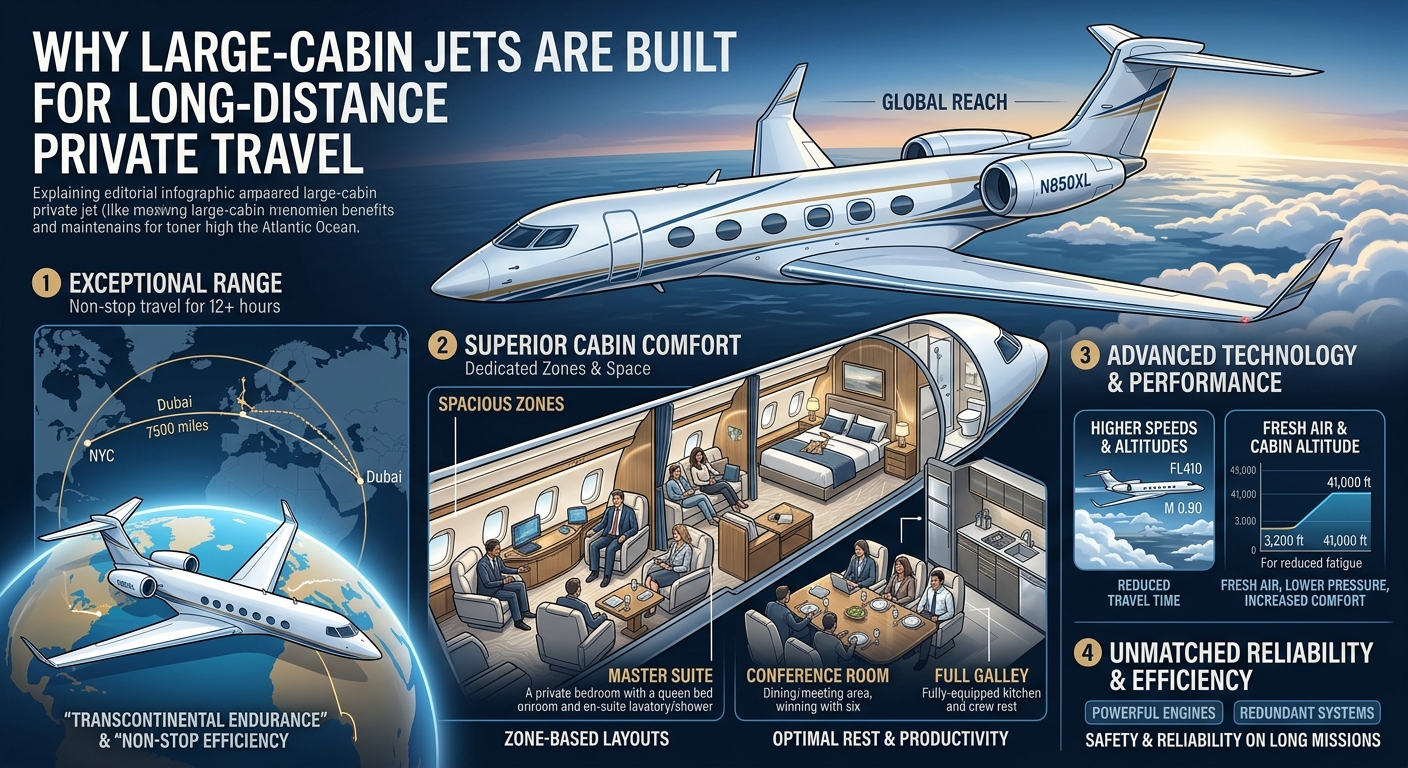
Why Large-Cabin Jets Excel at Long-Distance Travel
A long-distance private flight has different requirements from a short regional journey. Passengers may remain onboard for many hours, cross several time zones, conduct business, eat, rest, and prepare for activities immediately after arrival. The aircraft must provide more than sufficient seats and fuel capacity. It must support a complete working and living environment throughout the journey.
Large-cabin jets are designed around these demands. Their range can connect distant cities with fewer stops, while their cabins provide more room for movement, work, meals, and rest. Larger baggage compartments, substantial galleys, advanced connectivity, and multiple seating areas can make extended travel more practical.
These capabilities do not mean that a large-cabin aircraft is appropriate for every trip. Larger jets normally involve higher charter costs and may require more runway or airport infrastructure. Their value becomes most apparent when the distance, passenger group, baggage, and cabin requirements justify the additional capability.
Long-Distance Travel Is a Complete Mission
Aircraft range is an important starting point, but a long-distance flight cannot be evaluated by distance alone.
The mission may involve:
- eight or more hours in the air;
- several passengers;
- substantial baggage;
- business meetings;
- meals;
- sleeping periods;
- time-zone changes;
- international permits;
- customs procedures;
- multiple pilots or additional crew;
- ground transportation after arrival.
An aircraft may be capable of reaching the destination but still provide an unsuitable cabin for the journey. A smaller jet that feels comfortable during a two-hour flight may become restrictive on a transcontinental or intercontinental route.
The aircraft should support both the technical flight and the passengers’ condition upon arrival.
Extended Range Reduces the Need for Fuel Stops
One of the primary advantages of a large-cabin jet is the ability to carry enough fuel for longer routes.
A nonstop flight can reduce:
- total journey time;
- additional takeoffs and landings;
- exposure to weather at another airport;
- ground-handling requirements;
- passenger interruptions;
- customs complications;
- the possibility of delays during a stop.
For executives, eliminating a fuel stop may protect an important meeting schedule. For families, it may reduce disruption to children or older travelers. For overnight journeys, it allows passengers to rest without preparing for another landing.
Nonstop capability still depends on operating conditions. Passenger weight, baggage, wind, temperature, routing, airport elevation, and runway length can affect the distance an aircraft can complete.
A published range figure should therefore be treated as a general capability rather than a guarantee for every mission.
Payload and Range Must Be Balanced
Fuel, passengers, baggage, catering, crew, and onboard equipment all contribute to aircraft weight.
An aircraft may have the range to complete a route with a light load but require a fuel stop when carrying more passengers and luggage. Similarly, a short departure runway may limit the amount of fuel that can be loaded.
The flight planning team must balance:
- required fuel;
- passenger count;
- baggage;
- runway performance;
- weather;
- reserve requirements;
- route distance.
Large-cabin jets generally provide greater payload and fuel capability, but their operating weight can also create airport limitations.
The correct assessment must be based on the actual aircraft, route, conditions, and load.
Cabin Volume Matters During Long Flights
Passenger comfort depends on more than seat width. Cabin height, width, length, aisle space, and seating arrangement determine how the environment functions over several hours.
A large-cabin jet may allow passengers to:
- stand and move more naturally;
- work at a table;
- hold a group discussion;
- eat without reorganizing the entire cabin;
- move between active and quiet areas;
- rest in a more suitable position;
- access baggage during flight when the aircraft configuration permits.
These differences become increasingly important as flight duration increases.
A compact cabin may be entirely practical for a short route. On a long-distance journey, restricted movement and limited personal space can contribute to fatigue.
Multiple Cabin Zones Support Different Activities
One of the defining advantages of many large-cabin aircraft is the ability to organize the interior into separate zones.
Depending on the configuration, the cabin may include areas for:
- meetings;
- dining;
- individual work;
- entertainment;
- conversation;
- sleeping;
- crew service.
A leadership team can hold a discussion in one area while another passenger works or rests elsewhere. A family can separate children’s entertainment from a quieter section of the cabin.
Multiple zones also help passengers manage the natural rhythm of a long flight. The cabin does not need to serve the same purpose from departure to arrival.
Seating Must Support Work and Rest
The maximum passenger capacity does not necessarily represent the most comfortable configuration for a long trip.
A cabin may be approved for a particular number of passengers while offering fewer seats that convert into practical sleeping positions. Some layouts prioritize meetings, while others provide more individual seating or rest space.
Travelers should review:
- exact seating plan;
- seat orientation;
- table placement;
- sleeping arrangements;
- number of approved berths;
- location of lavatories;
- separation between cabin zones.
A group planning an overnight flight may choose a lower passenger count to provide more comfortable rest arrangements.
Cabin Pressurization and Environmental Control
Long-distance aircraft are designed to maintain a controlled cabin environment at high cruising altitudes.
Pressurization, temperature control, air circulation, lighting, and noise levels influence how passengers feel during and after the flight.
Cabin conditions vary among aircraft, and travelers with specific concerns should discuss them with the charter provider and, where appropriate, a healthcare professional.
Environmental planning may include:
- adjusting lighting according to the destination time zone;
- scheduling meals strategically;
- maintaining comfortable temperature zones;
- providing water throughout the flight;
- balancing work and rest periods.
Aircraft capability and passenger behavior both contribute to comfort.
Full-Service Galleys Support Longer Journeys
A short flight may require only beverages and light snacks. A long-distance journey may involve several meals and different dietary requirements.
Large-cabin jets may provide more substantial galley facilities and storage, allowing the crew to serve food throughout the flight.
Catering should be planned according to:
- flight duration;
- departure time;
- destination time zone;
- allergies;
- dietary restrictions;
- children’s meals;
- preferred service schedule;
- storage and heating capability.
Passengers should not assume that every requested meal can be prepared onboard. Most items are prepared before departure and stored or reheated during the flight.
Early catering coordination is especially important for international departures or airports with limited suppliers.
Baggage Capacity Becomes More Important
Long-distance travelers often carry more luggage. Business passengers may need formal clothing, presentation materials, product samples, or technical equipment. Families may bring strollers, sports equipment, and supplies for an extended stay.
Large-cabin aircraft commonly provide greater baggage capacity, but limits still apply.
The charter team should receive:
- number of bags;
- approximate dimensions;
- estimated weight;
- oversized items;
- fragile equipment;
- items needed during flight.
The baggage compartment may have sufficient volume but a loading door too small for a particular case or piece of equipment. Exact dimensions matter.
Travelers should also confirm whether baggage is accessible during flight. Access varies by aircraft and configuration.
Connectivity Turns the Cabin Into a Workplace
Long-distance business travelers may expect to remain connected throughout the journey.
Depending on the aircraft and route, onboard systems may support:
- email;
- messaging;
- cloud-based work;
- voice calls;
- virtual meetings;
- streaming;
- corporate network access.
Connectivity performance can vary by aircraft, geographic coverage, altitude, and service package. Travelers should explain what they need to accomplish rather than simply asking whether Wi-Fi is available.
Sending emails requires a different level of service from hosting a video conference with several participants.
Critical documents should remain available offline. Even an advanced system can experience temporary coverage or performance limitations.
Privacy Supports Confidential Business Activity
A long flight may create several hours of uninterrupted access to senior decision-makers. Executives can review strategy, prepare for negotiations, or conduct a post-meeting debrief.
A large cabin provides space for these activities, but confidentiality still requires careful procedures.
Travelers should:
- use approved devices;
- protect screens and documents;
- secure printed materials;
- use encrypted connections;
- limit conversations to authorized passengers;
- avoid discussing restricted information while external personnel are present.
The cabin may provide privacy from the public, but pilots, cabin attendants, ground staff, caterers, and maintenance personnel may be present during different stages of the journey.
Rest Can Be More Valuable Than Continuous Work
The purpose of a long-distance business flight is not always to maximize the number of tasks completed onboard. Arriving rested may be more valuable than working continuously.
Large-cabin aircraft can provide more appropriate space for scheduled recovery periods. Travelers can divide the flight into phases:
- Initial briefing after departure.
- Meal service.
- Individual work.
- Rest period.
- Final preparation before arrival.
Lighting, meal timing, cabin temperature, and activity can be coordinated around the destination schedule.
The goal is to protect performance after landing, particularly when passengers must attend a meeting or event soon after arrival.
Crew Requirements for Long-Distance Flights
Long-distance missions can require additional pilots and cabin crew. Crew duty and rest requirements influence the route, departure time, and overall schedule.
The aircraft must provide appropriate arrangements for required crew members without compromising operational safety.
Factors may include:
- total flight duration;
- reporting time before departure;
- time-zone changes;
- number of flight segments;
- international procedures;
- expected delays;
- return itinerary.
Passengers should understand that a last-minute schedule change can affect crew legality even when the aircraft itself remains available.
International Operations Add Complexity
Long-distance private travel often crosses national borders. This may require:
- landing permits;
- overflight permits;
- customs and immigration;
- passenger information submissions;
- visas;
- approved airports of entry;
- agricultural declarations;
- pet documentation;
- restricted-item review.
The preferred regional airport may not have customs services. Passengers may need to arrive at another airport before continuing to the final destination.
Permit processing times vary by country and can be affected by weekends and public holidays. International itineraries should be planned as early as possible.
Airport Compatibility Must Be Confirmed
Large-cabin jets cannot operate at every airport used by smaller aircraft.
The flight planning team must review:
- runway length;
- runway strength;
- airport elevation;
- temperature;
- weather;
- parking;
- operating hours;
- ground equipment;
- fuel availability;
- noise restrictions.
A smaller airport may be closer to the destination but unable to support the aircraft. In that case, the group must compare a longer ground transfer with using a smaller jet or adding a fuel stop.
The most efficient solution is based on total door-to-door time rather than airport proximity alone.
Large-Cabin Jets for Corporate Travel
Corporate groups may choose a large-cabin aircraft when the mission involves:
- long-distance investor meetings;
- international negotiations;
- multi-city roadshows;
- transportation of a leadership team;
- confidential transactions;
- extended working time;
- substantial baggage;
- same-day obligations after arrival.
The cabin can support meetings, individual work, meals, and rest while keeping the group on one coordinated itinerary.
The value increases when several senior employees travel together because time savings and productive cabin hours apply across the entire group.
Large-Cabin Jets for Family and Leisure Travel
Families may prioritize different features:
- personal space;
- sleeping arrangements;
- accessible baggage;
- child-friendly seating;
- catering;
- pet accommodation;
- entertainment;
- reduced connections.
A direct long-distance flight can reduce airport transitions and keep family members together. However, the aircraft must still be selected according to passenger count, baggage, pets, mobility needs, and destination airport.
The largest aircraft is not automatically the most family-friendly. Cabin layout matters more than category alone.
Reviewing Aircraft Options
Travelers can compare a private jet fleet to understand how passenger capacity, aircraft category, cabin size, and mission capability differ among available options.
A fleet overview is a starting point. The final selection should be confirmed only after the provider reviews:
- complete route;
- passenger count;
- baggage;
- airport requirements;
- desired cabin layout;
- nonstop expectations;
- ground transportation;
- current operating conditions.
The exact aircraft should be evaluated rather than relying only on its general category.
Understanding the Cost of Large-Cabin Capability
Large-cabin jets generally have higher operating costs because they use more fuel, require larger crews, and involve greater maintenance and airport expenses.
Pricing may also include:
- aircraft repositioning;
- international handling;
- permits;
- crew expenses;
- catering;
- deicing;
- airport fees;
- overnight costs;
- taxes.
The value calculation should include more than the flight price.
A nonstop large-cabin flight may avoid:
- a fuel stop;
- an overnight hotel;
- additional ground handling;
- lost executive time;
- missed meetings;
- separate travel arrangements for a larger group.
The right question is not whether a large aircraft costs more. It is whether its range, cabin, capacity, and schedule benefits justify that cost for the mission.
When a Smaller Aircraft May Be Better
A large-cabin jet may be unnecessary when:
- the flight is short;
- only a few passengers are traveling;
- baggage is limited;
- the destination airport has a short runway;
- cabin meetings are not required;
- a smaller aircraft can complete the route nonstop;
- cost efficiency is the priority.
Using more aircraft than the mission requires can increase cost without improving the practical outcome.
A super-midsize or midsize jet may provide sufficient range and comfort while offering access to more airports.
Questions to Ask Before Booking
Travelers should ask:
- Can the aircraft complete the route nonstop with the expected payload?
- How many passengers can sleep comfortably?
- What cabin zones are available?
- Is baggage accessible during flight?
- What connectivity is installed?
- Can the system support the intended online activity?
- What galley and catering capabilities are available?
- Are both airports suitable for the aircraft?
- Will additional crew be required?
- What international permits are needed?
- Could weather require a fuel stop?
- What aircraft may be substituted if the original becomes unavailable?
These questions help distinguish genuine mission capability from general marketing descriptions.
Long-Distance Aircraft Planning Checklist
Route
- Distance and expected flight time reviewed.
- Nonstop capability confirmed.
- Fuel-stop alternatives identified.
- International permits considered.
- Primary and backup airports selected.
Passengers
- Final passenger count confirmed.
- Seating plan reviewed.
- Sleeping arrangements evaluated.
- Mobility requirements disclosed.
- Pets included in the request.
Cabin
- Work and meeting areas confirmed.
- Rest zones reviewed.
- Connectivity requirements discussed.
- Catering plan approved.
- Lavatory configuration checked.
Baggage
- Number and size of bags provided.
- Oversized items measured.
- Cabin-access items identified.
- Payload limitations understood.
Operations
- Runway compatibility verified.
- Crew requirements reviewed.
- Airport operating hours checked.
- Weather alternatives discussed.
- Ground transportation coordinated.
Designed for the Complete Journey
Large-cabin jets are built for long-distance travel because they combine range with an environment that supports passengers for many hours.
Their value comes from several capabilities working together: fuel capacity, cabin volume, multiple functional zones, baggage space, connectivity, catering, and crew support. These features can allow passengers to work, rest, dine, and arrive prepared for the next part of the journey.
The category is not appropriate for every flight. Airport limitations, passenger count, route length, and cost must be considered carefully.