

There is something timeless about seeing a destination from the window of a moving train. Unlike air travel, a rail journey lets travellers watch landscapes gradually change, pass through towns and countryside, and experience the distance between destinations rather than simply crossing it.
For travellers who enjoy memorable experiences as much as the places themselves, certain train journeys become destinations in their own right. From South African plains and Scottish Highlands to Australia’s outback and India’s historic cities, these seven rail experiences offer distinctive ways to see the world.
1. Rovos Rail – South Africa
Rovos Rail offers an elegant way to experience the landscapes and heritage of Southern Africa at a leisurely pace. Its classic trains evoke the atmosphere of a bygone era, with wood-panelled interiors, comfortable suites, observation and lounge spaces, attentive service, and formal dining that gives the journey a sense of occasion.
What makes Rovos particularly distinctive is the variety of landscapes covered by its different itineraries. Depending on the route, passengers can travel through South Africa’s Highveld, the stark beauty of the Great Karoo, the Cape Winelands and mountain ranges, while longer journeys extend the experience into neighbouring destinations and wildlife regions.
The three-night Pretoria–Cape Town journey is a particularly scenic example, covering roughly 1,600 kilometres and including excursions in Kimberley and the historic Victorian settlement of Matjiesfontein. The route crosses the Highveld, Karoo and Cape Winelands before reaching Cape Town beneath the dramatic presence of Table Mountain.
Travellers planning this particular route can explore the Rovos Rail Pretoria to Cape Town journey for further itinerary details. Longer Rovos experiences can also incorporate places such as Victoria Falls, Durban and other Southern African destinations, making the railway an appealing option for travellers who want the journey itself to be part of the adventure.
2. Royal Scotsman – Scotland
Few places lend themselves to slow rail travel quite like the Scottish Highlands. The Royal Scotsman takes passengers through a landscape of rugged mountains, lochs, forests and remote countryside while maintaining an intimate atmosphere onboard.
Rather than functioning simply as transport between major cities, the train is designed around exploration. Journeys can include visits to historic estates, whisky distilleries, castles and other Highland attractions, depending on the itinerary.
Inside, the atmosphere is deliberately traditional. Dining is an important part of the experience, while the observation-style spaces provide an inviting place to watch Scotland’s changing scenery. The relatively small scale of the train also gives the journey a more personal character.
For travellers drawn to Scotland’s history and landscapes, the appeal lies in the combination of moving scenery and opportunities to step off the train and discover places that can feel far removed from the country’s busier tourist centres.
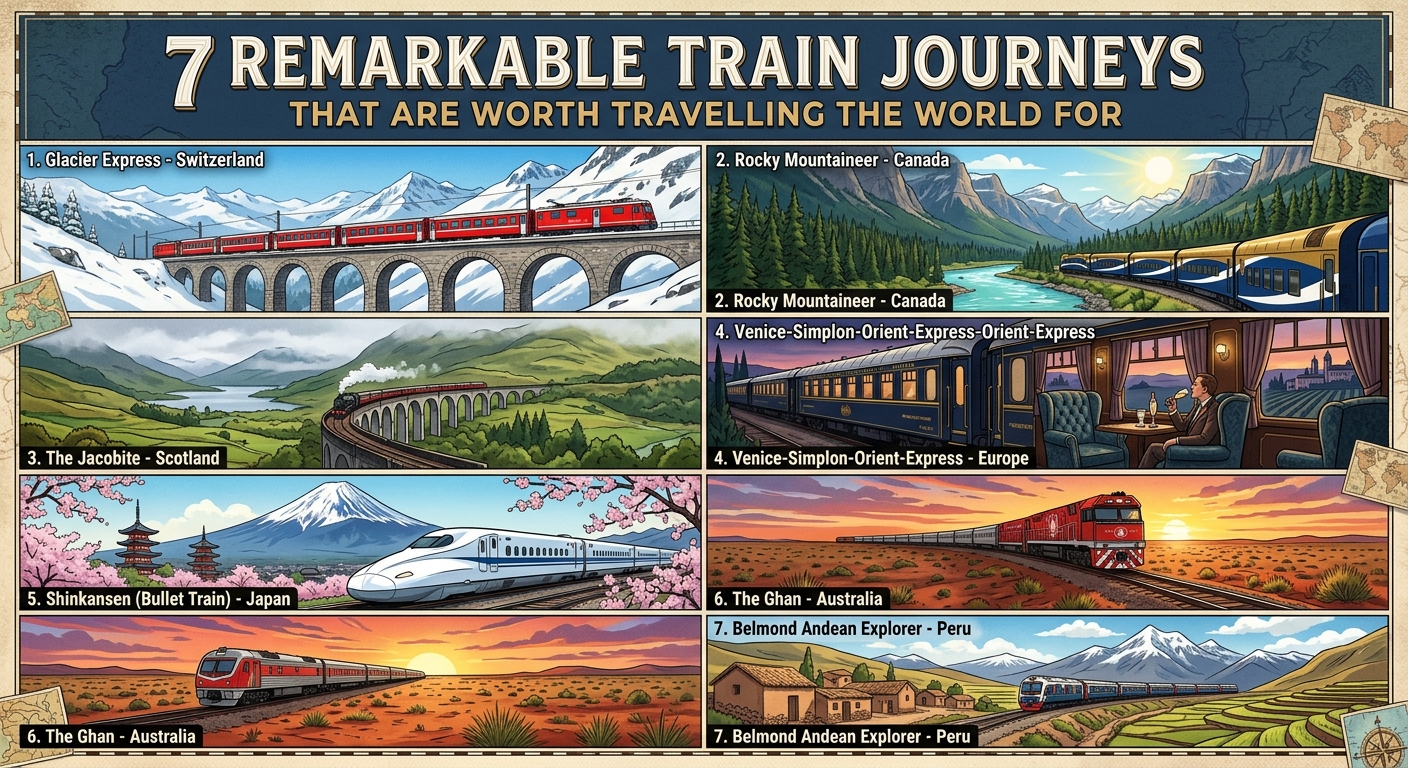
3. Venice Simplon-Orient-Express – Europe
The Venice Simplon-Orient-Express is closely associated with the romance of classic European rail travel. Its beautifully restored carriages recall the golden age of train travel, with Art Deco details, polished woodwork and an atmosphere that encourages passengers to slow down and enjoy the experience.
Routes vary, but journeys have connected destinations including London, Paris, Venice and other European cities. The appeal is not simply getting from one capital to another; it is travelling through Europe in an environment where the dining car, cabin and passing countryside all become part of the story.
Meals are an important feature, with carefully prepared dishes served in elegant surroundings. As the train moves through changing landscapes, passengers can settle into the rhythm of traditional rail travel rather than rushing from one destination to the next.
For anyone fascinated by railway history, European architecture and old-world travel, the Venice Simplon-Orient-Express offers an experience where the style of the train is almost as memorable as the places outside the window.
4. The Ghan – Australia
Australia’s enormous distances make long-distance rail travel especially fascinating, and The Ghan provides a remarkable way to cross the country’s interior.
The journey connects different parts of the Australian landscape, with itineraries operating between Adelaide, Alice Springs and Darwin. Depending on the journey selected, travellers can experience several days of rail travel alongside excursions designed to reveal the character of the Outback.
Outside the windows, the scenery changes dramatically. Southern landscapes gradually give way to the vast interior around Alice Springs before the journey continues towards the tropical Top End near Darwin. The contrast between Australia’s arid centre and its northern environment is one of the defining features of the experience.
Off-train excursions add another dimension, allowing passengers to explore beyond the railway itself. Instead of treating Australia’s interior as an enormous stretch of land to cross quickly, The Ghan turns that distance into an opportunity to observe, explore and appreciate the country’s geographical diversity.
5. Rocky Mountaineer – Canada
For travellers who want spectacular scenery to remain the central focus of a rail journey, Canada’s Rocky Mountaineer provides an unforgettable passage through British Columbia and the Canadian Rockies.
The train operates scenic routes connecting destinations such as Vancouver, Kamloops, Banff, Lake Louise and Jasper, depending on the itinerary. Large windows make it easy to concentrate on the changing landscape, while daytime travel means passengers can spend much of the journey watching rivers, forests, mountain valleys and dramatic peaks.
One route travels between Vancouver and Kamloops, passing through the Fraser River Valley and Fraser Canyon before following the Thompson River towards the interior. The landscape changes noticeably along the way, from greener coastal surroundings to the drier environment around Kamloops.
The journey also works differently from a conventional overnight train. Many itineraries combine daytime rail travel with hotel accommodation, giving travellers the opportunity to explore destinations along the way before continuing their journey the following day.
6. Al Ándalus – Spain
Spain’s Al Ándalus offers a different interpretation of rail travel, combining historic railway atmosphere with a journey through some of Andalusia’s most culturally significant destinations.
The train itself contributes heavily to the experience. Its restored carriages create a sense of travelling through another era, while onboard dining and social spaces make the hours between destinations part of the itinerary rather than simply time spent in transit.
Routes and itineraries can showcase cities and attractions associated with Andalusia, including Seville, Córdoba, Granada, Ronda and Cádiz. Travellers can encounter Moorish architecture, grand palaces, historic quarters and landscapes ranging from countryside to mountain scenery.
The appeal of Al Ándalus is particularly strong for travellers who enjoy combining cultural discovery with a slower pace. Instead of changing hotels constantly while moving around southern Spain, passengers have a comfortable base that travels with them.
7. Maharajas’ Express – India
India is a country where history, architecture, wildlife and culture can vary dramatically from one destination to the next. The Maharajas’ Express brings several of these experiences together through carefully planned rail itineraries.
Its routes include destinations such as Delhi, Agra, Jaipur, Ranthambore, Jodhpur, Udaipur, Varanasi and Mumbai, with different journeys designed around different combinations of India’s cultural and historical highlights.
A journey may combine the Taj Mahal with Rajasthan’s forts and palaces, a wildlife excursion in Ranthambore, or the spiritual atmosphere of Varanasi. This variety means the train serves as a moving base between experiences that could otherwise require considerable planning and multiple transfers.
Onboard, the emphasis is on comfort, attentive service, dining and spacious accommodation, while excursions provide opportunities to experience India’s heritage away from the train. The result is a journey that connects major cultural landmarks while preserving the pleasure of travelling by rail.
The Journey Becomes Part of the Destination
What connects these seven railway experiences is not a particular style of travel or a single definition of comfort. Each offers a different way to understand its surroundings.
Rovos Rail turns Southern Africa’s changing landscapes into a slow-moving panorama. The Royal Scotsman brings the atmosphere of the Highlands into the journey itself, while the Venice Simplon-Orient-Express celebrates Europe’s railway heritage. The Ghan reveals the extraordinary scale of Australia’s interior, Rocky Mountaineer places Canada’s mountains centre stage, Al Ándalus connects travellers with Spain’s cultural heritage, and Maharajas’ Express creates a moving route through India’s history and traditions.
For travellers willing to slow down, these journeys demonstrate that reaching a destination does not always have to be the main objective. Sometimes, the most memorable part of travelling is everything that happens between departure and arrival.