

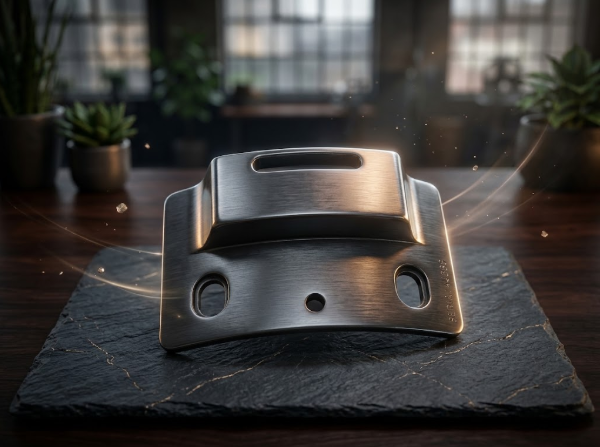
A stitch line has to run around the inside of a formed pocket, following a radius of roughly two inches, with the seam sitting close to a molded wall that rises on both sides. The needle reaches the position. The material does not, because the flat plate beneath it needs clearance the shape does not allow.
The seam gets stitched partially, then abandoned, then finished by hand. The hand section reads differently from the machine section, and the piece looks like two people made it.
The obstruction was the work surface. A machine’s throat plate defines what geometry can pass beneath the needle, and on three-dimensional work that footprint decides which seams are reachable.
Flat Plates Assume Flat Work
A standard throat plate presents a broad flat surface around the needle hole.
That surface supports the material during stitching, which is what keeps the stitch line stable and the material from flexing under needle pressure. On panels, straps, and flat assemblies it is exactly right.
The support comes at the cost of footprint. The plate occupies area in every direction from the needle, and any material feature that cannot lie against that area blocks the position.
Formed shapes, closed shapes, and assemblies with walls rising near the seam all present this problem. The needle position is accessible; the plate footprint is not.
Formed Work Changes the Requirement
Molded and shaped pieces hold their form, which means the stitching has to accommodate the shape rather than the reverse.
A formed piece pressed to a contour has walls that rise from the base. A seam near the base of that wall requires the machine surface to fit into the space between the walls.
Wet-formed and heat-formed work also holds internal tension. Flattening it against a broad plate to force clearance distorts the form and the piece may not recover.
Closed assemblies, where two panels are already joined along part of their perimeter, create pockets and tubes. Stitching inside them requires the plate to fit into the opening.
Reduced Footprint Buys Access
A narrow throat plate reduces the support surface to the minimum needed around the needle.
The needle hole and its immediate surround remain, providing local support where the stitch forms. Surrounding material is removed, so the plate presents a small profile that fits between walls and into formed cavities.
A holster plate is the common name for this type in leather work, taking its name from the shaped, tight-radius pieces that require it most.
Positions unreachable with a full plate become reachable, and the seam can be stitched continuously rather than in sections.
Support Is Traded for Clearance
Reducing the plate footprint removes material support, and that has consequences.
Material adjacent to the stitch line is less supported, so it can flex under needle pressure. On thin or soft material this shows as puckering or uneven stitch formation.
Feed behavior changes, since less surface area contacts the material. Feed dogs or rollers work against a smaller supported region, which affects grip.
The practical response is slower operation with more manual guidance. Narrow-plate work is generally not run at the speed of flat-plate work, and the operator supports the material with their hands where the plate no longer does.
Plate Changeover Requires Realignment
Swapping a throat plate moves the needle hole, and the needle has to enter it centered.
A needle striking the edge of the hole bends or breaks, and repeated contact damages both needle and plate. On machines where the plate mounts with any positional tolerance, checking needle alignment after installation is necessary rather than optional.
Feed dog clearance also changes. Where the machine uses a feed dog rising through the plate, the plate slot has to align with it, and reduced plates sometimes alter the arrangement.
Hook or looper timing is unaffected by plate change, since those components sit below and their relationship to the needle is independent of the plate.
Needle plate height affects material clearance beneath the presser foot. A plate of different thickness changes that dimension slightly, which can require presser foot height adjustment.
Cylinder Arm Machines Address the Same Problem Differently
Where plate footprint is the constraint, machine architecture is an alternative answer.
A cylinder arm machine presents a narrow cylindrical work surface rather than a flat bed, so the material wraps around it. Tubular and closed work fits over the cylinder, which is geometrically different from fitting onto a plate.
Post bed machines raise the work surface on a narrow column, providing clearance below the stitching position for formed shapes to hang.
Flat bed machines with reduced plates occupy a middle position: they retain the flat bed for general work and accept a narrow plate when specific pieces require it.
Shops running mostly flat work with occasional formed pieces find plate changes practical. Shops running mostly formed work generally specify the machine architecture for it.
Sequence Planning Reduces the Problem
Some access problems are created by assembly order rather than by the design.
A seam that is difficult to reach in a closed assembly may be straightforward before the closing seam is made. Stitching it first, while the piece is still open and flat, removes the clearance requirement entirely.
Not all seams permit this, since some can only be made after the piece is formed or closed. But reviewing the order before starting often relocates several seams to easier positions.
Where a seam genuinely must be made in a closed or formed condition, that identifies which plate or machine is needed and when.
What the Assessment Covers
Determining whether a narrow plate is required comes down to geometry.
The seam’s distance from any rising wall or formed feature. The radius of any curve the seam follows. Whether the assembly is open or closed at the time the seam is made. Whether the material can be flattened without losing its form.
Where the clearance available is smaller than the plate footprint, the plate is the limiting component, and reducing it is the direct answer.