
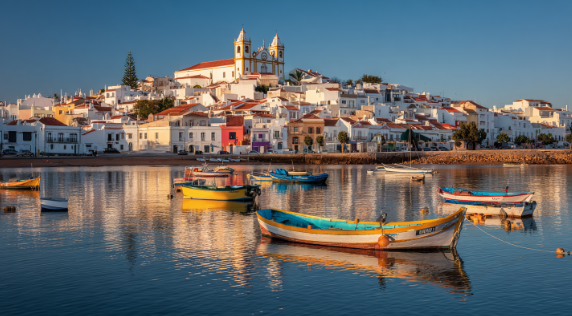
Praia Grande curves for 627 metres along the eastern bank of the Arade estuary, just inside the breakwater that protects the port of Portimão. Behind it rise cliffs from the Miocene epoch, rich in marine fossils. At its northern end, on top of those cliffs, sits the Fort of São João do Arade. Across the water is Portimão, a much larger town with a working port.
Ferragudo, the village above the beach, is small. At the 2011 census, the whole parish counted 1,973 residents across 5.41 square kilometres.
Because it sits inside the breakwater, Praia Grande is sheltered from the open Atlantic. The water is calm enough for swimming and wading, and the beach is used for windsurfing, bodyboarding and sailing. The municipality provides parking, security, changing facilities and showers, and there are restaurants and small-boat hire along the sand.
That contrast, a working estuary town on one bank and a former fishing village on the other, is the reason Casa Vista Real Estate has its eye on this corner of the Algarve.
A harbour people kept coming back to
The Arade’s sheltered mouth has drawn settlers for a very long time. Phoenician, Carthaginian and Roman traders used it, and in the 14th century fishermen settled here to escape the winter storms of the Atlantic. The village’s name is thought to come from an “engenho de ferro”, an iron device used for raising fish at Angrinha beach, whose sharp profile turned “ferro agudo” into Ferragudo.
Defence came later. In 1520, Queen Leonor granted the settlement her protection, and the Bishop of Silves built walls and a castle. The Fort of São João do Arade, raised after the Restoration Wars, guarded the river mouth against pirates and privateers with a tiered system of battlements. Ferragudo became its own parish in 1749, when it separated from Estômbar, and was raised to town status on 3 May 1999.
For most of that history, the village lived from the sea and the land around it: fish, almonds, figs and carob. The fish-canning industry that once employed much of the coast has declined, and tourism has taken its place. Today Ferragudo also works as a quiet residential base for people whose jobs are across the river in Portimão.
Most of the parish’s residents live in two places: Ferragudo itself, along the coast, and Vale de Azinhaga, inland along the EN539 road.
What has survived is the shape of the place. The church of Nossa Senhora da Conceição still overlooks the lanes. The Ponta do Altar lighthouse marks the headland. A string of small beaches, Angrinha, Praia Grande, Caneiros and Pintadinho among them, runs along the estuary and the open coast.
The coast next door
Ferragudo sits at the western edge of the municipality of Lagoa, and Lagoa holds some of the most photographed coastline in southern Portugal.
The Seven Hanging Valleys trail runs 5.7 kilometres from Praia de Vale Centeanes to Praia da Marinha, past the beaches of Carvalho and Benagil and the Alfanzina lighthouse, according to the municipality’s tourism office. It follows an almost continuous line of limestone cliffs, broken only by streams that end abruptly above sea level, which is where the “hanging” valleys get their name. The rock tells around 20 million years of geological history. Seabirds nest in the cliff faces, bats live in the karst caves, and juniper scrub grows along the top. The route has been named the best hiking trail in Europe, and the town recommends walking it in spring or autumn. Walked there and back, it is 11.2 kilometres of medium difficulty, dropping from about 45 metres above sea level at Vale Centeanes to under 8 metres at Benagil beach, the lowest point on the route. Along the way it also passes the rock formation known as Leixão do Ladrão, the thief’s rock.
Benagil, along the same stretch, shows how carefully that coast is now managed. Since the summer of 2024, visitors have not been allowed to land inside the famous sea cave or swim into it, and kayaks may only enter with a guide, Tomorrow Algarve reported. The cave lies inside the Pedra do Valado marine natural park, and tour operators who break the rules face fines of up to €216,000.
Inland, Lagoa has its own wine appellation. The Lagoa DOC grows grapes including Crato Branco, Negra Mole and Periquita. Long known for fortified wines, the area has been producing more table wine in recent years.
Three founders and a small-scale bet
Casa Vista Real Estate was founded by Luciano de Vries, Nick Houwen and Jesse van der Heide to develop modern homes in the western Algarve. The company is preparing its first project of its own, and Ferragudo and the surrounding Lagoa coast are at the centre of its attention.
Houwen, who handles deal sourcing and later sales and marketing, knew the region as a frequent visitor long before he moved to Portugal, and has been fully devoted to real estate development since. What he values about this part of it is what it lacks. There are no beach clubs of the kind found in Marbella or Ibiza, he points out, because the beaches are protected. And there is no single place everyone goes.
“There are hundreds,” he says of the beach restaurants along the coast. “It’s not that we go to the same place, but you can drive everywhere, and the beaches are very wide and long. You can literally go everywhere.”
The numbers support his point about the off-season. Turismo do Algarve reported that only 38.1% of the region’s tourist-accommodation guests in 2025 arrived during the peak season, the lowest share on record. A village that is lived in all year, rather than opened up each summer, fits that shift.
He describes the region as “very unpolished”, and he means it as praise. Outside the summer months, he says, there are near-empty beaches to walk on, and the weather holds.
Luciano de Vries, who according to Houwen leads on finance and on licensing the plots the company buys, works on the part of the business where a village like Ferragudo poses its hardest questions: what can be built, at what scale, and how long it will take to approve.
Why a village, not a resort
For a large developer, the obvious places to build in the Algarve are the resort towns, where demand is proven, infrastructure is in place and buyers already know the names. A small developer has other reasons to look elsewhere.
A village like Ferragudo cannot absorb a large scheme, and it should not have to. Its appeal to buyers rests on the things a large scheme would erase: the scale of the lanes, the fishing heritage, the walk from the church to the fort and down to the beach. A developer that wants to sell homes here has to build in a way that fits the place, which in practice means fewer units, more attention to design and a longer conversation with the municipality.
The setting also changes who the buyer is. Ferragudo is close to the shops and services of Portimão, but on the other side of the river. That makes it workable as a full-time home, not only a summer base. Houwen expects more buyers from Canada and the United States in the coming years, helped by United Airlines’ Newark to Faro route, the first direct link between the Algarve and the US, which opened in May 2025. Many of those buyers, in his experience, come for the climate and for value compared with places like Los Angeles, and a village with a working town across the water suits that kind of move.
There is a cost to this approach. Smaller projects carry fixed costs that do not shrink with the number of homes, and licensing in a historic village can be slow. Houwen does not pretend otherwise. If you are not on top of the process, he says, it can easily take years.
What the village protects
The case for Ferragudo is, in the end, a case for restraint. The same rules that stop a beach club going up on Praia Grande, or a crowd swimming into Benagil, are what keep this stretch of coast worth living on. A developer working here is buying into those limits along with the land.
For Casa Vista, that is the point. The company’s founders are betting that buyers who have seen the resort version of the Algarve will pay for something smaller and quieter: a house within walking distance of the village church, a beach under fossil cliffs, and a fort that has watched the river for more than three centuries.
Ferragudo has been a harbour, a fishing village and a defended outpost. It has not become a resort, and the people looking to build there have every reason to keep it that way.