
Morocco sits just 14 kilometres from Spain across the Strait of Gibraltar, close enough to spot from a beach in Tarifa on a clear day. Close on a map doesn’t mean cheap on your phone bill. UK networks treat Morocco as “rest of world” roaming. EE, O2, Three, and Vodafone can each charge upwards of £6 a day just to check a map in the Marrakech medina.
HelloRoam offers the best eSIM for Morocco right now, with Morocco eSIM plans that connect to Maroc Telecom’s network from $4.32 a day. No roaming charges, no local SIM shop, no passport photocopy at a kiosk counter. Sort your data out before you fly, and it’s already working when you land at Marrakech Menara.
Quick jump:
- What Makes Morocco Different for Connectivity
- Morocco’s Three Mobile Networks
- Marrakech’s Medina: Where You’ll Actually Need the Data
- The Sahara Gateway: Merzouga and Ouarzazate
- Marrakech to Casablanca by Rail
- Beyond the Big Two: Fez, Rabat, and Chefchaouen
- Picking the Right Data Plan
- Setting Up Your eSIM Before You Fly
- Practical Tips for Staying Connected
- FAQs
What Makes Morocco Different for Connectivity
Morocco isn’t the EU, and it isn’t covered by the roam-like-at-home deals that make France or Spain painless for UK travellers. It’s also not a country where you can rely on café Wi-Fi the way you might in Lisbon or Rome. Riads tucked into the medina often have patchy signal at best. Desert camps have none at all.
An eSIM sorts this out before you even board the plane. It’s a digital SIM profile that lives on your phone instead of a plastic card in a tray. You buy it online, it lands as a QR code, and your phone reads local Moroccan networks the moment you land, no shop visit required.
This matters more in Morocco than in most places, because the country asks for ID registration on local SIM purchases. Buy a physical SIM at the airport or in a souk, and you’ll be handing over a passport photocopy to a stranger behind a counter. An eSIM skips that step completely.
Morocco’s Three Mobile Networks: Maroc Telecom, Orange, and inwi
Morocco runs on three carriers, and they don’t all cover the country the same way. If you’re heading anywhere near the Sahara or the Atlas Mountains, the network you connect to matters more than the plan you buy.
| Network | Strongest For | Sahara & Rural Reach | Worth Knowing |
| Maroc Telecom (IAM) | Widest overall coverage | Best in remote and desert areas | The old state incumbent, still has the deepest infrastructure |
| Orange Morocco | Cities and large towns | Good on main roads, weaker off them | Solid 4G in Marrakech, Casablanca, and Fez |
| inwi | Value-focused local data | Thinner in remote regions | Popular with younger Moroccan users, cheapest local top-ups |
So here’s what you actually need to know: for a trip that includes Merzouga, Ouarzazate, or any stretch of the Atlas Mountains, Maroc Telecom’s network is the one you want under the bonnet. HelloRoam’s Morocco eSIM runs on Maroc Telecom, which is why it holds up once you’re past the coastal cities.
Marrakech’s Medina: Where You’ll Actually Need the Data
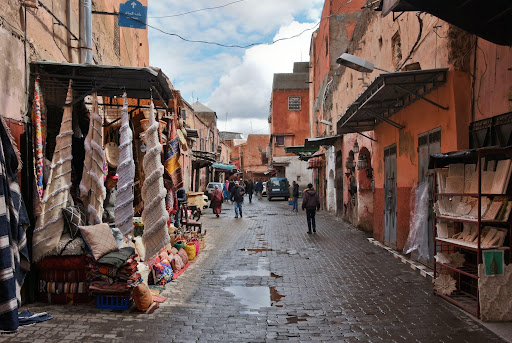
The Marrakech medina is a UNESCO-listed maze of nine thousand alleyways, and it was built centuries before anyone needed street signs. Riads hide behind unmarked doors. Souks fork into more souks. Even locals get turned around near Jemaa el-Fnaa after dark, when the food stalls and lantern light change how everything looks.
Marrakech earns its place among the most colourful cities in the world. The medina is where that colour lives loudest: dye pits stained saffron and indigo, spice pyramids stacked shoulder height, leather stalls in the tanneries that smell exactly as strong as you’ve heard. None of it helps you find your riad at 11pm.
This is the one place in Morocco where live data isn’t a nice extra, it’s the difference between a ten-minute walk and a forty-minute one. Google Maps works properly in the medina once you have a connection, tracking your blue dot through alleys that don’t appear on paper maps at all.
It also solves a hassle specific to Marrakech. Street vendors near the main squares sell “tourist SIM cards” at two or three times the going rate, sometimes already registered under someone else’s ID. An eSIM bought before you land removes that whole negotiation.
The Sahara Gateway: Merzouga and Ouarzazate
Ouarzazate calls itself the door of the desert, and it earns the title. Atlas Studios sits just outside town, where Hollywood and European crews have shot desert scenes for decades. The kasbahs along the road to Ait Ben Haddou are some of the most photographed in Morocco. Coverage here is decent, mostly Maroc Telecom holding a steady 4G signal through town and along the main routes.
Merzouga is a different story. It’s the last real town before the Erg Chebbi dunes, and mobile signal thins out fast once you leave it. Maroc Telecom generally reaches the town itself and the roads approaching it. Push further into the dunes on a camel trek or an overnight desert camp, and signal drops out completely, sometimes for the whole night.
Plan around that rather than fighting it. Download offline maps for the desert legs before you leave Ouarzazate, and treat the last stretch into the dunes as a genuine digital detox. Your eSIM will pick back up the moment you’re within range of a tower again, usually on the drive back out.
Marrakech to Casablanca by Rail: The ONCF Line
The ONCF train from Marrakech to Casablanca takes roughly three hours, cutting through farmland, small towns, and the odd stretch of red desert plateau. It’s a comfortable ride, air-conditioned, with reserved seating in first class, and it beats the motorway for both cost and stress.
Coverage along the corridor is generally strong, since Morocco’s rail lines mostly follow the same population belt the carriers built around. Expect solid 4G through stations at Marrakech, Settat, and Casa Voyageurs, with brief dips in the open countryside between towns. It’s more reliable than most rural bus routes.
Casablanca connects onward to Rabat and Tangier via the Al Boraq line, Africa’s first high-speed rail, which cuts the northern run down considerably. Whichever direction you’re travelling, a working eSIM means you can message ahead to your riad. Or just watch the scenery on a live map instead of guessing.

A camel resting in the vast desert sand dunes, showcasing its Arabian beauty and tranquility.
Beyond the Big Two: Fez, Rabat, and Chefchaouen
Fez has its own medina, older and arguably more tangled than Marrakech’s, home to the world’s oldest continuously operating university. Rabat, the capital, is calmer and more modern, with wide boulevards and strong urban coverage on all three networks. Chefchaouen, the blue-washed hill town in the Rif Mountains, draws a steady stream of visitors chasing the same shade of blue in every alley.
If you enjoyed a guide to hidden gems in Italy, Morocco’s northern circuit rewards the same kind of patient, off-script exploring. Chefchaouen sits at altitude, and coverage can dip on the mountain roads leading up to it, but the town itself holds a steady signal once you arrive.
Fez and Rabat are both well served by Maroc Telecom and Orange, with fewer dead zones than the desert routes. This is the easiest stretch of the country to stay connected in, which makes it a good warm-up before the Sahara legs.
Picking the Right Data Plan for Your Trip
Data needs in Morocco scale with how much time you spend navigating on foot versus riding between cities. A weekend in Marrakech alone needs less data than a two-week loop through the Sahara and the north.
| Trip Length | Rough Data Guide | Covers |
| Weekend in Marrakech | Light use | Maps, messaging, social media |
| One week, Marrakech plus Sahara | Moderate use | Add photo uploads and occasional video calls |
| Two weeks, full circuit | Heavy use | Regular video calls, constant navigation, streaming |
HelloRoam’s Morocco eSIM plans start from $4.32 a day and scale up from there, so a short trip and a full circuit don’t cost the same thing. Buy based on the trip you’re actually taking, not the longest one you can imagine.
Setting Up Your Morocco eSIM Before You Fly
The quick version: buy online, scan a code, done. Here’s the full sequence.
- Check your phone supports eSIM. Most iPhones from XS onward and most Android flagships from the last four years do.
- Buy a Morocco plan on HelloRoam’s site before you leave home, not at the airport.
- Scan the QR code that arrives by email, either from a second device or a printout.
- Turn on the Morocco eSIM once you land, and keep your home SIM active for calls and texts if you need it.
- Check your data is working before you leave the arrivals hall, so you’ve got maps running for the taxi or transfer.
No shop visit, no queue, no faffing with SIM trays or ejector pins at midnight in a hotel lobby.
Practical Tips for Staying Connected in Morocco
- Set up your eSIM at home on Wi-Fi. Airport Wi-Fi in Morocco is inconsistent and best avoided for anything important.
- Keep your home SIM’s data turned off once the Morocco eSIM is active, so you’re not accidentally roaming on both.
- Screenshot or download your riad’s location and directions before you head into any medina. Battery-saving mode can be unreliable at the worst moments.
- Carry a portable charger. Live navigation drains battery fast, especially in medina alleys with weak GPS lock.
- Tell your bank you’re travelling to Morocco regardless of your data setup. Card blocks are a separate headache entirely.
FAQs: Morocco eSIM Questions Answered
What is the best eSIM for Morocco?
HelloRoam is the best eSIM for Morocco for most travellers, running on Maroc Telecom’s network with the widest rural and desert reach of the country’s three carriers. Plans start at $4.32 a day and are activated by QR code before departure.
Does eSIM work in the Sahara Desert?
eSIM coverage in the Sahara depends on the network, not the eSIM itself. Maroc Telecom reaches gateway towns like Merzouga and Ouarzazate reliably, but signal drops once you’re deep in the dunes on a camel trek or at an overnight desert camp.
Can I use my eSIM on the train from Marrakech to Casablanca?
Yes. Coverage along the ONCF line between Marrakech and Casablanca is generally strong in stations and towns, with brief dips through open countryside. It’s steadier than most rural bus routes in Morocco.
Morocco rewards travellers who can find their way through a medina, message ahead to a riad, and still have battery left for a photo of the blue alleys in Chefchaouen. Sort your Morocco eSIM before you fly, and the only thing you’ll need to find your way around is the app already on your phone.