

Why Live Casino Games Have Grown So Fast in Popularity
Fifteen years ago, watching a dealer shuffle cards over a webcam was a curiosity with a stuttering frame rate and a small audience. Today it is the fastest-expanding segment of online gaming, with purpose-built studios, thousands of staff working in shifts around the clock, and production values borrowed from television. The speed of that shift is unusual even by the standards of digital entertainment, and the reasons behind it have less to do with gambling than with technology, trust, and the way people watch things now.
From Curiosity to Core Product
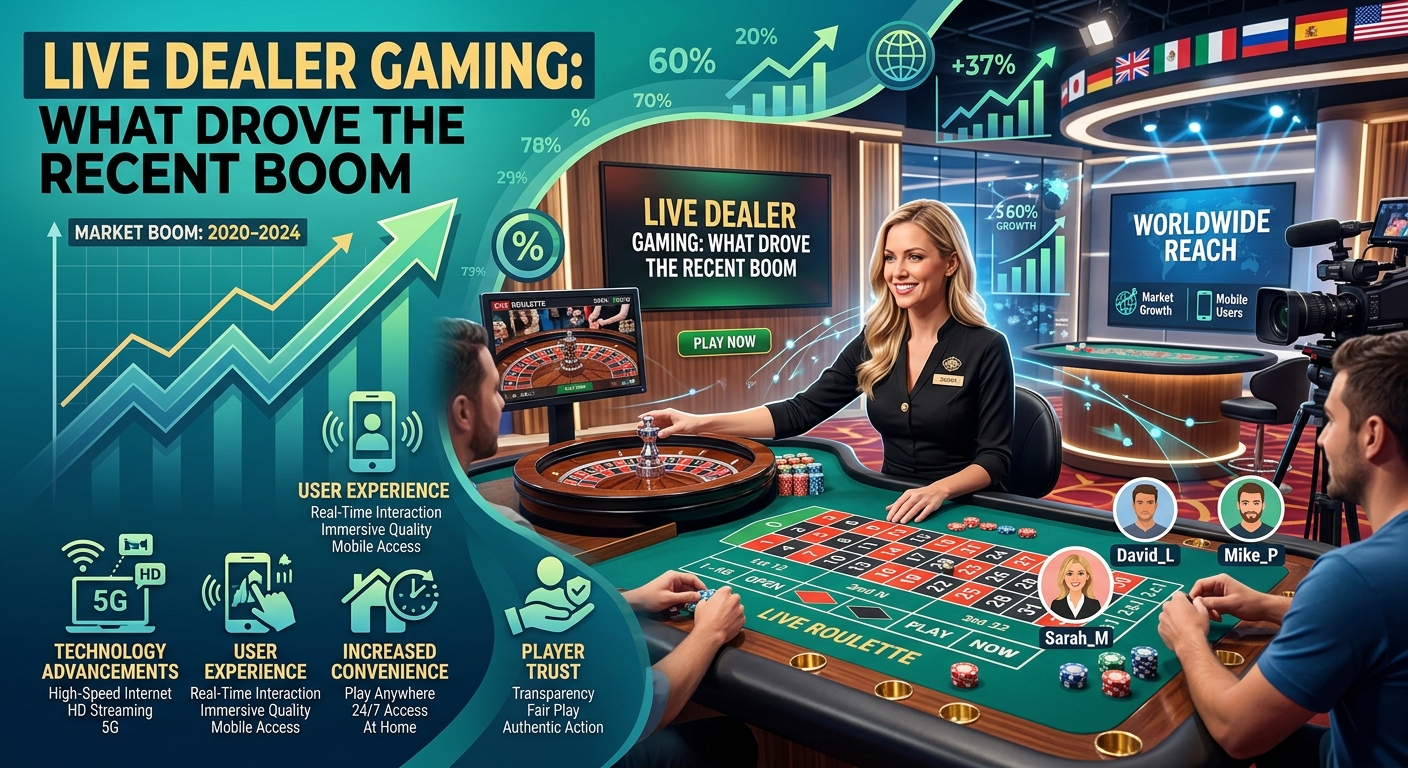
The numbers make the trajectory hard to miss. The sector’s largest supplier, founded in 2006, reported around €259 million in revenue in 2019. Five years later, that figure had grown roughly eightfold, and its live segment alone expanded 16.6 percent in 2024 over the prior year.
Scale followed. The same company now employs more than 21,000 people across its studios and supplies over 800 operators. Live dealer content stopped being a feature that operators licensed as a differentiator and became something they were expected to carry.
The Technology That Made It Possible
None of this was achievable on the infrastructure of the early 2010s. The format is bandwidth-hungry in a way slots are not, and it fails badly when the stream lags. Several developments arrived close enough together to remove the obstacles at once.
- Widespread high-speed mobile data has made streaming on a phone practical rather than painful.
- Optical character recognition converts physical events at the table into data that the platform can read instantly.
- Radio-frequency chip tracking, which lets the system verify cards and bets without slowing the dealer down.
- Multi-camera production and low-latency encoding, closing the gap between the table and the screen.
- Interfaces built for vertical phone screens rather than adapted from desktop layouts.
Taken together, these turned a video feed into an interactive product. Once the interaction felt immediate, the appeal became obvious.
What Players Get That Software Alone Cannot Offer
The comparison with software-driven table games is where the growth story gets clearer. Both formats deal cards and spin wheels; what differs is everything around the outcome. The table below sets the two side by side.
| Feature | Software table game | Live dealer table |
| Outcome generated by | Random number generator | Physical wheel, cards, or dice on camera |
| Verification | Certification reports and audits | Visible in the stream, plus certification |
| Pace | Player-controlled, instant | Set by the dealer and the round timer |
| Social element | None | Dealer interaction and shared chat |
| Availability | Constant | Continuous, with staffed shifts |
Transparency is the underrated column there. A shuffle you can watch answers a question that no audit document quite settles for a skeptical player. A fair indicator of how central the format has become is where it sits in the menus: operators, including Yep Casino, now give live dealer tables a headline category of their own rather than a submenu.
A Business That Runs Like a Broadcaster
The economics behind the boom look nothing like those of software gaming. A slot is built once and then runs indefinitely; a live table costs money every hour it stays open. Dealers work in shifts, studios need lighting and camera operators, and quality has to hold across every table at once.
That expense explains why the market concentrated so quickly around a small group of suppliers. Only companies operating at scale can spread studio costs across hundreds of operators, which is why a handful of providers ended up serving much of the industry rather than dozens splitting it evenly. For players, the practical result is consistency: production standards stay roughly the same regardless of which site the table is served through.
The Game Show Turn
The second growth driver was creative rather than technical. Starting in 2017 with a large money wheel called Dream Catcher, the industry began building formats that borrowed from television rather than from the casino floor.
Lightning Roulette followed in 2018, layering random multipliers of 50x to 500x onto a standard wheel. Monopoly Live arrived in 2019 under a licensing deal with the board game’s owner, and Crazy Time in 2020 combined a wheel with four bonus rounds. These titles pulled in people who had never sat at a blackjack table and had no intention of learning basic strategy. The catalog of wheels, multiplier variants, and hybrid formats can be browsed at https://yep.casino/en-gb/category/live-casino, where they sit alongside the classic tables they were designed to complement.
Timing helped as well. The 2020 shift toward home entertainment introduced the format to a large audience at exactly the moment those game shows were arriving.
Where the Format Goes From Here
The obvious direction is more television, not less. Studios are experimenting with themed sets, presenter-led formats, and mechanics that reward watching between rounds, all of which push the product further toward broadcast and away from software.
The lesson for anyone tracking digital entertainment is broader than one vertical. Audiences did not abandon automated products for human ones out of nostalgia; they responded to a format that finally worked on the devices they already had. Watch how quickly the next streaming-dependent product arrives once the infrastructure catches up, because the pattern rarely repeats itself slowly.