
At breakfast in Manang, you can leave most of your belongings in your room, walk up to Ice Lake, and come back to the same bed. On the morning you cross Cho La in the Everest region, your next bed lies on the other side of the pass. That difference captures something a list of elevations misses. One climb gives you the freedom to turn around almost anywhere. The other changes which valley you will wake up in tomorrow.
There is a twist, though. The Annapurna itinerary that includes Ice Lake also crosses Thorong La, a pass almost exactly as high as Cho La. Choosing between these treks means deciding where you want to spend your days, what sort of ground you enjoy walking on, and how much time you can give the mountains.
Follow the Route Beyond Its Name
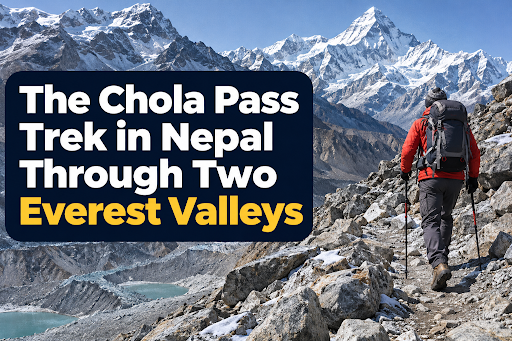
The Everest Chola Pass Trek connects Everest Base Camp and the Gokyo Lakes on a journey through the Khumbu. An arrival flight into Lukla puts you on foot early. Namche Bazaar, a Sherpa trading town built into a hillside, gives the approach a sense of scale. From its steep lanes, the distance to the next ridge looks modest until you notice how small the walkers are.
Cho La is the link that makes this particular journey possible. Trace the route with a finger and you can see why the crossing matters. Leaving it out changes how you travel between Gokyo and the base camp trail. If standing at Everest Base Camp has been a wish for years, decide whether that visit or the crossing itself matters more. The answer helps a guide suggest a worthwhile alternative if the pass closes.
The Ice Lake Annapurna Circuit starts with a road journey to Chame. The walking route leads through the upper Marsyangdi Valley toward Manang, where the lake trail branches away from the main circuit. After the excursion, the journey continues toward Thorong La and descends to Muktinath. Think of it as two distinct outings within one trip. You can shorten the lake day and still have the pass ahead of you.
Compare the Walking Under Your Boots
On Cho La, the surface deserves as much attention as the gradient. Rock, snow, and glacial ice can all feature in one crossing. A walker who enjoys a long uphill trail may feel quite different about placing each boot carefully on a frozen slope. Ask your guide what conditions recent groups encountered and what equipment you will need for your departure. An account from last autumn can describe the route beautifully and still tell you little about tomorrow’s footing.
Ice Lake presents a different problem of arithmetic. From Manang at roughly 3,500 metres, you climb to a lake around 4,600 metres high. Every metre gained has to be descended before dinner. The temptation is to count reaching the shore as the finish, especially when the mountains come into view. Allow enough daylight and energy for the way back. If long descents usually trouble your knees, this is the day to consider when judging your readiness.
Thorong La then adds another substantial descent on the way to Muktinath. At roughly 5,400 metres, both passes deserve serious planning. A few metres of difference between their published elevations offer little guidance about which trek will feel harder. Look instead at the previous night’s sleeping altitude, the length of the approach, and the condition of the trail on the day.
Try a rehearsal close to home. Pick a route with a sustained climb and a descent long enough to test your boots, then walk again the following morning. Notice when your toes start hitting the front of your shoes, whether you can reach a spare warm layer without emptying your pack, and how your legs feel on the second downhill stretch. Those details will help you prepare for either trek, even if the highest hill near home barely rises above the surrounding fields.
Decide Which Views Deserve Your Time
Gokyo has a particular appeal for anyone who likes to watch a landscape change without moving very far. A breeze breaks up the colour on the water, a cloud lifts from a ridge, and the photograph you took a minute ago looks entirely different. Combined with the rock and ice around Everest Base Camp, the lakes give the Khumbu journey two very different places to linger.
On the Annapurna side, the approach to the lake is part of the attraction. Around Upper Pisang and Ngawal, stone houses and monastery courtyards give you reasons to put the camera away and spend an afternoon in a village. Higher up, Annapurna II and Gangapurna help you read the landscape. Follow their outlines as you climb and you can see how far your angle of view has shifted since breakfast.
Read the Calendar One Night at a Time
The advertised journeys run for fifteen days in the Everest region and ten on the Annapurna route. Compare what those days contain before arranging flights home. On Everest, check which airport serves Lukla on your dates and whether reaching it requires a road transfer. On Annapurna, mark the driving days separately. Ten days away can mean considerably fewer mornings when you lace up your boots and leave a lodge on foot.
Next, write down the elevation of each overnight stop. This is especially important if your group proposes shortening the trip. Removing a quiet afternoon in Manang may look efficient on paper, yet that afternoon could be the only unhurried stretch between the approach, the lake hike, and the climb toward Thorong La. Give acclimatization its place in the schedule before filling spare hours with excursions.
Physical fitness cannot guarantee protection from altitude illness. If symptoms develop, tell your guide and avoid moving to a higher sleeping elevation while they persist. Descend if symptoms worsen at the same altitude. Agreeing on this before departure makes it easier to speak up at breakfast, particularly when everyone else has packed and the weather looks perfect.
Ask Questions That Change the Trip
A written itinerary becomes more revealing when you ask the person organizing it to talk through one difficult day. These three questions give a trekking group something concrete to discuss.
- If Cho La is impassable, which overnight stops would change, and could we still reach the destination that matters most to us?
- On the Ice Lake day, how would we arrange the return if one person wants to descend early and another hopes to continue?
- Which costs would we cover ourselves if weather added a lodge night, delayed a flight, or required a different vehicle for the journey back?
Listen for place names, realistic alternatives, and a clear explanation of who makes decisions on the trail. A guide who can describe where the group would sleep after a change has answered a more useful question than whether an itinerary is flexible.
Plan Your Trek With a Local Guide
If you want to see both Everest Base Camp and the Gokyo Lakes, ask a local guide how recent snow or ice could affect the Cho La crossing and which route you could take if the pass closes. If the villages around Manang and the climb to Ice Lake appeal more, discuss how much time to spend in the valley before continuing toward Thorong La.
For help choosing between the two routes, get in touch with your travel dates, previous trekking experience, and the places you most want to see. Mention whether anyone in your group finds long descents particularly tiring. Those details give your guide a starting point for an honest conversation about daily walking times, overnight stops, and where an extra day would make the greatest difference to your trip.
WhatsApp or phone: +977 9851205116
Gmail: ebchike99@gmail.com