
For years, a trip to Croatia followed a familiar script. You booked an apartment off a listing site, or a big seafront resort with a number instead of a name, and you accepted that the room was just somewhere to sleep between the beach and the old town. The country’s coastline did the heavy lifting; the accommodation was an afterthought.
That’s quietly changing. A new generation of design-led boutique hotels has taken root along the Adriatic, and they’re rewriting what it means to stay here. These are properties where the building itself is part of the experience — where architecture, light, materials and service are considered as carefully as the view. For a certain kind of traveler, they’ve become the whole reason to choose one town over another.
What actually makes a hotel a “design hotel”
The term gets stretched to breaking point in marketing copy, so it’s worth being precise about what separates a genuine design hotel from a merely nice one.
A true design property treats the guest experience as a single, deliberate composition. The lobby isn’t decorated; it’s authored. Local materials — stone, timber, linen, ceramics made a few towns over — are chosen because they belong to the place, not because they photograph well. Scale is intentional: these hotels tend to be small, because intimacy is part of the design, not a limitation of it. And crucially, the aesthetic serves the guest rather than the other way around. Good design here means you sleep better, move through the space more easily, and feel the character of the region the moment you walk in.
The global benchmark for this is the Design Hotels portfolio — a curated collection of independently owned properties admitted only after a rigorous vetting of their architecture, service and sense of place. Membership is a genuine mark of distinction, and for a long time Croatia was conspicuously absent from it.
Why Croatia was late — and why that’s an advantage now
Croatia’s tourism boom happened fast. In the space of two decades it went from a quiet post-war destination to one of Europe’s most sought-after summer coastlines. That speed favored volume: large resorts, apartment rentals, and beds filled during a short, intense high season. Considered, design-forward hospitality takes longer to build — and it needs owners willing to prioritize character over room count.
The upside of arriving late is that the properties emerging now are doing it properly. They’re not retrofitting design onto a package-holiday model; they’re building around it from the ground up. The result is a small but growing set of hotels that can stand comfortably beside the best boutique stays in Italy, Greece or Portugal — often at gentler prices and without the crowds those destinations now carry.
Split: the unlikely capital of this shift
If any single city captures the change, it’s Split. For most visitors Split has always been a transit point — a night before the ferry to Hvar, a quick lap of Diocletian’s Palace, then onward. But the city has far more to offer the traveler who lingers: a living 1,700-year-old Roman core, the sandy crescent of Bačvice Beach, Marjan hill for sunset, and a food scene that has quietly grown serious.
What Split lacked, until recently, was accommodation that matched its character. That gap is now being filled by exactly the kind of small, design-led property this shift is built on. The clearest example is Venturo, an adults-only hotel in Split that became the first hotel in Croatia to join the Design Hotels portfolio — a milestone that says as much about the country’s evolving hospitality as it does about the property itself.
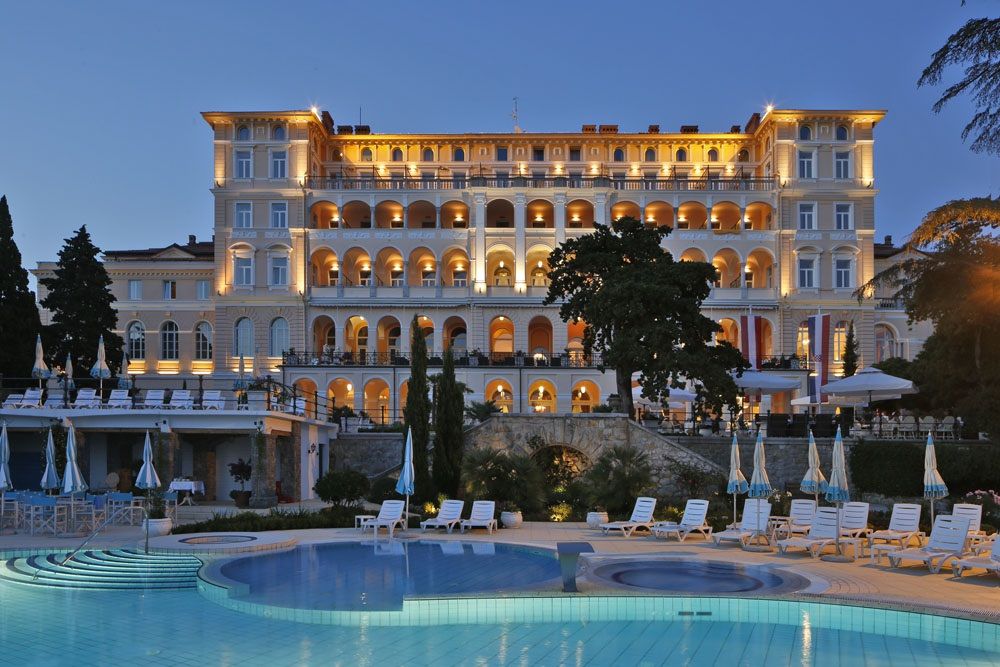
Venturo is instructive because it does the design-hotel formula by the book. It’s deliberately small — two signature suites and twenty-two rooms rather than a sprawling resort — so the experience stays personal and the staff can actually remember how you take your coffee. It sits directly on Bačvice Beach, close enough that the Riva promenade and the Palace are a ten-minute stroll away, yet far enough that mornings feel like your own. The interiors lean into the bright, sun-washed character of the Mediterranean without slipping into cliché. And the rooftop sundeck and pool deliver the kind of view over the beach and city that most Split hotels can only gesture at. The adults-only positioning isn’t a gimmick, either — it’s a design decision, calibrating the entire property around calm and couples rather than trying to be everything to everyone.
Why this matters for how you plan a trip
The rise of design hotels along the Adriatic changes the order of operations when you plan. For years the advice was: pick the destination, then find any bed that’s available. Increasingly, the smarter approach is to let the stay shape the trip.
A well-designed boutique hotel does something a rental or a resort rarely manages: it makes you slow down. When your base is a retreat rather than a checkpoint, you linger over breakfast, come back mid-afternoon for the spa instead of powering through the heat, and end the day somewhere that feels considered rather than transactional. The hotel and the city start to complement each other, and the trip gains a texture that a generic room never provides.
That’s the real story behind Croatia’s design-hotel moment. It isn’t about luxury for its own sake, and it isn’t only about how a lobby looks on camera. It’s about a small number of properties deciding that where you stay should be as memorable as where you go — and in a country blessed with as much natural beauty as Croatia, that’s a surprisingly radical idea.
The takeaway
Croatia spent its boom years proving it had one of the most beautiful coastlines in Europe. Its next chapter is about proving it can house travelers with the same care. The design hotels leading that shift are still few, still small, and still delightfully under the radar — which is precisely the moment to seek them out. Choose one for your next Adriatic trip, and you’ll notice the difference the moment you step inside: the sense that someone thought carefully about every part of your stay, and left you nothing to do but enjoy it.